
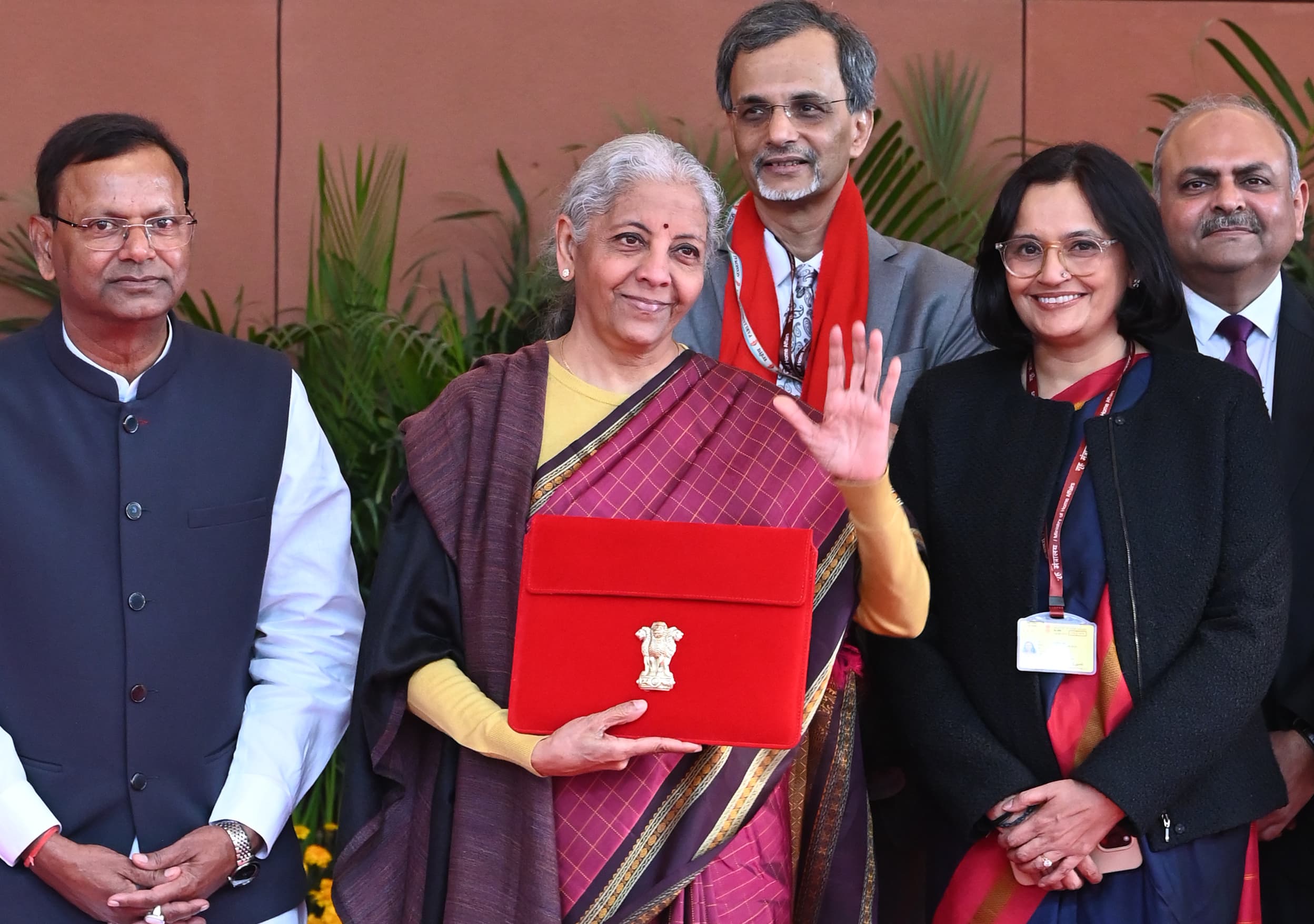
India’s finance minister projects modest fiscal consolidation in budget

India’s government plans a modest improvement in its fiscal picture in the coming financial year, with reductions in the fiscal deficit and debt, while boosting manufacturing in sectors ranging from textiles to chips.
Finance Minister Nirmala Sitharaman, in her ninth consecutive budget speech, said on Sunday that the government sees its fiscal deficit falling to 4.3% of GDP in the 2026-27 financial year, down from 4.4% in 2025-26.
Sitharaman said the government expects India’s debt-to-GDP ratio to fall to 55.6% in the coming financial year from 56.1% in 2025-26.
The finance minister pointed to the wider uncertainties facing India.
“Today, we face an external environment in which trade and multilateralism are imperilled and access to resources and supply chains are disrupted,” Sitharaman said. “New technologies are transforming production systems while sharply increasing demands on water, energy and critical minerals.”
The government plans to encourage manufacturing in seven key sectors, including semiconductors, rare-earth magnets, pharmaceuticals, chemicals, capital goods, textiles and sports goods.
India’s benchmark Nifty 50 stock index was down about 1.7% shortly after Sitharaman’s speech to parliament and closed 1.96% lower.
In its economic survey for the financial year 2026 released on Thursday, India said it sees its economy growing between 6.8% to 7.2% in the fiscal year 2027, outpacing most other major economies.
“As a growing economy with expanding trade and capital needs, India must also remain deeply integrated with global markets, exporting more and attracting stable long-term investment,” Sitharaman said.
Consultancy firm PwC India said the budget places the country “at a crossroads to push the nation into its next phase of transformation”.
“The Union Budget 2026-27 holds opportunities to set India’s role towards financial stability, while boosting businesses to be future ready — especially as they navigate the opportunities of AI adoption alongside challenges around talent, infrastructure, governance and trust,” PwC India said in an online commentary.
Source – Middle east monitor