
Washington scrambles to meet calls for AI guardrails while the window to act closes

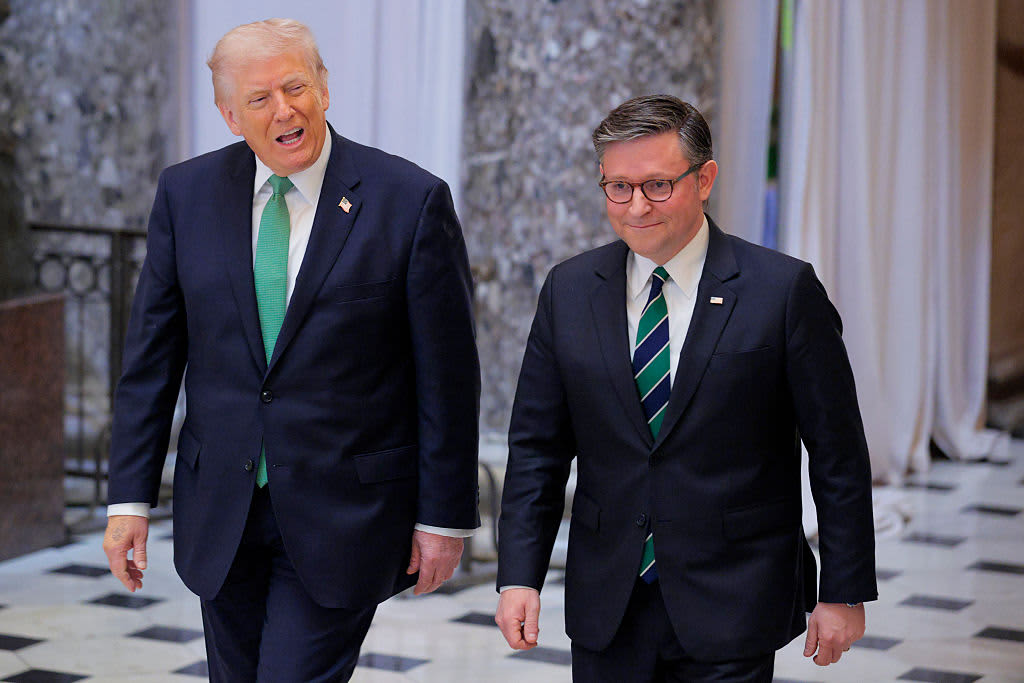
(L-R) U.S. President Donald Trump and U.S. Speaker of the House Mike Johnson (R-LA) depart the annual Friends of Ireland Luncheon in National Statuary Hall at the U.S. Capitol on March 17, 2026 in Washington, DC.
Chip Somodevilla | Getty Images
Washington is scrambling to address renewed fears over artificial intelligence, as leading U.S. companies sound the alarm over technology they say is advancing beyond their control.
“Dr. Frankenstein is telling us the monster is escaping; help us stop this,” said Sen. Ruben Gallego, D-Ariz., on CNN’s “State of the Union” on Sunday. “The method that we’re answering [with] is not meeting the moment.”
The push for action on AI safeguards comes after a researcher resigned from Anthropic and warned that the technology could “kill us all by the end of the decade.” Stunning pledges to slow development from the leaders of top AI frontier companies Anthropic, OpenAI and xAI followed the warning, and calls for lawmakers to act toward regulating the industry came soon after.
“Yesterday’s commentary by AI industry leaders should be heeded as a bright flashing red light telling the President and Congress they need to act now to regulate and rein in AI development,” Pennsylvania Gov. Josh Shapiro said in a post on X on Sunday. “This technology is powerful, with great potential to do good, and yet it comes with extraordinary risk. It’s not clear where it will lead but this much is clear: its development should not be steered exclusively by private entities, especially when the CEOs of those companies are calling out for restraint and regulation.”
The events have left Washington, which has done little to regulate AI since the technology emerged, with its back against the wall as the rapidly growing industry looks increasingly dangerous. Lawmakers now must grapple with how to rein in AI as an all-important midterm election looms and Congress prepares to leave town for another month to hit the campaign trail.
The episode sets up a test of whether lawmakers will respond to a crisis barreling toward them in a hyper-partisan Washington or head home to make their case for reelection with control of Washington on the line.
On Friday, a group of Democrats led by Rep. Sam Liccardo, D-Calif., wrote to House Speaker Mike Johnson, R-La., demanding to stay in session until it passes meaningful safeguards.
Johnson is scheduled to send the House home after this week until November’s elections have passed.
Rep. Sam Liccardo, D-Calif., walks down the House steps after a vote in the U.S. Capitol on Thursday, May 1, 2025.
Bill Clark | CQ-Roll Call, Inc. | Getty Images
“The House should return to Washington immediately and remain in session until Congress advances meaningful, bipartisan AI safeguards,” the letter, obtained by CNBC, read. “To our children who will have read a post-apocalyptic history, ‘Why Congress Slept’ —likely written by agentic AI—our inaction will be inexplicable, and unforgivable.”
The Democrats urged consideration of any number of proposals that have emerged in the House that “deserve consideration, public debate, thoughtful amendment, and action.” That includes bills mandating transparency and evaluation of frontier models, “kill switch” requirements and a waiver of antitrust laws to allow the industry to work together on safety and security.
House Democratic Leader Hakeem Jeffries on Sunday said on ABC’s “This Week” that Democrats would meet on Tuesday to discuss AI guardrails.
“We should take decisive action now so that we can slow down, as the CEOs have recently acknowledged, slow down the pace of development in order to protect the American people and ensure that AI is proceeding safely,” he said.
Johnson, however, appeared to rule out that Congress would quickly act on any of those priorities or stay in session beyond next week during an appearance on CNN Sunday.
“If Congress just races in and does some sort of emergency session to try to regulate AI, we will lose the race to China, that is a threat to every single American,” Johnson said. “We don’t need everybody to panic right now, we need to handle this new technology like we have others in the past, and make sure we’re doing everything we can responsibly to also not smother American innovation.”
Johnson called for a meeting between leaders in Washington and the leaders of the AI industry to settle on a path forward, while also calling on the companies themselves to self-police.
“I’d do it tomorrow,” he said. “I think we need to go in a big room, close the door and sort this out.”
Gallego called for a similar summit.
“The way you figure this out is, again, you use this sense of urgency to get the smartest people in the room,” he said. “But the way we’re going about this is that we’re hoping some committee in the House or Senate is just going to come together with some staffers and put together the framework that’s going to go into place maybe three years from now. We don’t have that time.”
Gallego, however, said that Johnson, President Donald Trump and Congress are all “not meeting the moment.” He also said the refrain that the U.S. will lose the AI race if it regulates the technology does not hold water.
“AI does not care once it becomes fully dangerous whether we’re Chinese or American,” he said. “That’s the danger of this; everyone’s thinking about this in a way that is based on old tech and not what’s going toward the future.”
Trump on Sunday pointed to China while appearing to critique a slowdown or regulation in AI development during brief remarks in Ireland.
“Well I say this, we’re leading China on AI. We’re the most sophisticated country in the world and frankly I want to keep it that way, because whoever wins AI wins,” the president said, according to a pool report. “We can put guardrails, and we can do this and that, but I think you have a lot of negative forces that are bringing it up and they’re bringing up things that won’t happen.”
While the House has introduced multiple proposals to put safeguards around AI, including the FRONTIER Act led by Reps. Jay Obernolte, R-Calif., and Lori Trahan, D-Mass., the Senate has been slower to coalesce around similar bipartisan proposals. A bill being worked on by Senate Majority Leader John Thune, R-S.D., and Sens. Amy Klobuchar, D-Minn., and Ted Cruz, R-Texas, has not yet been introduced.
Some in the AI industry are optimistic that Congress can do something before the midterm elections. An industry source familiar with the discussions in Washington said that legislation is likely to emerge in the coming week with “real momentum” behind it. The person noted that lawmakers on the ballot in November would like to point to an accomplishment on AI rather than stagnation.
— CNBC’s Kate Rooney contributed to this report.
Source – CNBC