“BRICS New Delhi Declaration reflects India’s diplomatic success, turns diversity into strength,” say experts
New Delhi [India], September 13 (ANI): The New Delhi Declaration adopted at the 18th BRICS Summit reflects the success of Indian diplomacy in bringing together diverse member states despite differences and geopolitical contradictions, experts and journalists said on the sidelines of the summit in the national capital on Sunday.
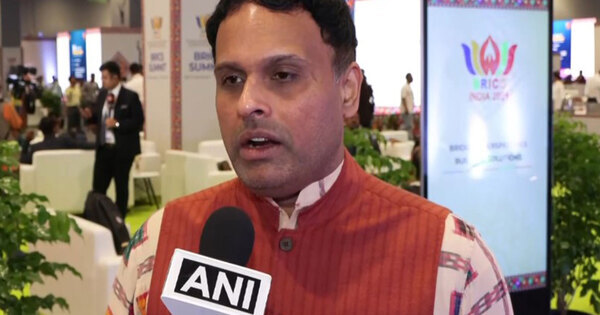
Prof (Dr) Sreeram Chaulia, Dean of the Jindal School of International Affairs at OP Jindal Global University, termed the outcome a ‘spectacular’ success for India’s diplomacy and multilateral engagement.
Speaking to ANI, Chaulia said, ‘It’s a spectacular outcome. It is a success for Indian diplomacy, for our multilateral skills, and for being able to manage a lot of contradictions among different member states. We could get all of them together on the shared minimum common denominator.’
He said that while the expansion of BRICS could have been expected to increase differences among members, India managed to turn the group’s diversity into an advantage.
‘Normally you think that as the expansion happens, there will be more differences and divisions. Diversity may lead to discord and dissonance. But instead, India converted what could be a weakness into a strength. And we use language as per their respective national positions,’ he said.
Chaulia noted that this approach was particularly visible in the Declaration’s references to contentious geopolitical issues.
‘You would see that phrase many times in the Delhi Declaration, especially on very contentious issues like the ongoing wars and all those things–geopolitical tensions… we, through our leadership, demonstrated that it is possible, even in a highly polarised world, that we can create some working basis for cooperation, even in times of complete breakdown of cooperation at the larger global level,’ he added.
Marco Alpeggiani, Journalist with the European Press Federation, highlighted the Declaration’s discussion on terrorism and international law.
Speaking to ANI, Alpeggiani said, ‘The first thing about terrorism is a wider discussion. Whoever doesn’t follow and apply international law, in a way, is a terrorist. It doesn’t matter if it’s a small organisation, a big organisation, a small state, or a big state… we are against any form of terrorism.’
He added, ‘Economic sanctions are also a form of terrorism. I think they made the statement to widen the definition of terrorism, not just to a group of a few people, but also to an international organisation.’
South African journalist Siyabonga Goodman Madondo said it was important for BRICS members to arrive at the Declaration, which addresses several global challenges and calls for greater stability.
Speaking to ANI, Madondo said, ‘It was important that the Declaration be arrived at. It’s a 45-page-long document with a lot of points that were added, including the need for BRICS countries to distance themselves from becoming part of the war in Iran and the Middle East. Basically, our countries must look at what is supposed to happen and address these issues. The declaration has a lot of points, essentially declaring a commitment towards a safer Africa and a safer world, because these wars have an impact on everyone else.’
‘We need investment, we need a growing economy across the board, and we must chart a clear way for Africa and the rest of the world to maintain stability in our countries. Human trafficking was also one of the issues touched upon because these things have an impact on human rights, which are violated every day,’ he added.
Madondo said the Declaration would need implementation and further work. ‘So, basically, the declaration itself is a work in progress. It needs to be implemented, but there is no definitive timeline for when that will happen. These are issues that confront the world, and we need to be clear and firm about how we go about resolving them,’ he said.
On India-Ethiopia ties, Daniel Tirunesh Shiferaw from Ethiopia’s Eyudan Media said the BRICS platform offered opportunities to deepen cooperation between the two countries.
‘It’s a big opportunity for Ethiopian and Indians. We have a long relationship with the Indian government. In education, business, trade, and also technology, we have a big collaboration with the Indian government and Ethiopians,’ Shiferaw said.
Speaking about his visit to India, he said, ‘This is my first visit to India…Indians know how to promote themselves, and they know how to take care of heritage. Based on that, they are getting a lot of tourism. So, I hope they are changing for the business and tourism sector.’
On India’s BRICS presidency, he said, ‘It’s big. This is the centre of BRICS. India is hosting; it’s very well organised.’
Indonesian freelance journalist Mega Mei Wahidawati said Indonesia’s participation in the summit was significant as the country joined BRICS last year.
Speaking to ANI, she said, ‘Indonesia just joined BRICS last year. So, this is the first time we are joining the BRICS Summit. I just hope that BRICS will make our country stronger and strengthen our relationships with other countries, especially India and other member countries.’
Referring to the New Delhi Declaration, she said, ‘The New Delhi Declaration was released yesterday. There are so many points mentioned in the New Delhi Declaration, but personally, as an Indonesian journalist, I want to highlight several issues that are important for Indonesia and BRICS. For example, they recalled our Asia-Africa Conference in Bandung, which aims to bring greater equality and fairness among countries. That’s why I believe that a fairer world is good for everyone.’
She also highlighted cooperation in aviation, saying, ‘They also mentioned that aviation will be improved through BRICS. Some countries will help and support Indonesia in the aviation sector.’
TV BRICS Africa journalist Melissa Hollow said the Declaration contained several areas of cooperation, including greater representation for women at the United Nations and support for Africa’s role in the UN.
Speaking to ANI, she said, ‘If you look at the Delhi Declaration, it has a lot of cooperation within it. One of the things which I found interesting was the fact that, given that there’s no female representation in the UN, India came through to say that this is something that they could support. Also, the support for Africa to be part of the United Nations was something to highlight,’ Hollow said.
She also pointed to health, currency and trade cooperation among BRICS countries.
‘In terms of building the population and being a healthy population, the declaration speaks from 2026 to 2029. That is something to look forward to, as to what will come out of that. In terms of just re-emphasising the currency conversation and talking about the inter-trade currency, that also speaks to collaboration because we need to work with each other to make sure we’re trading in our local currencies,’ she added.
Earlier, PM Modi welcomed leaders on the second day of the 18th BRICS Summit on Sunday.
The session is expected to provide an opportunity for BRICS leaders to deliberate on areas of common interest and discuss ways to strengthen cooperation among member countries while advancing an inclusive approach to global growth.
PM Modi will later have meetings with several leaders on the sidelines of the BRICS Summit. (ANI)
Source – Indonesia News