Judge dismisses Alaska Senate election lawsuit; DOJ vows appeal

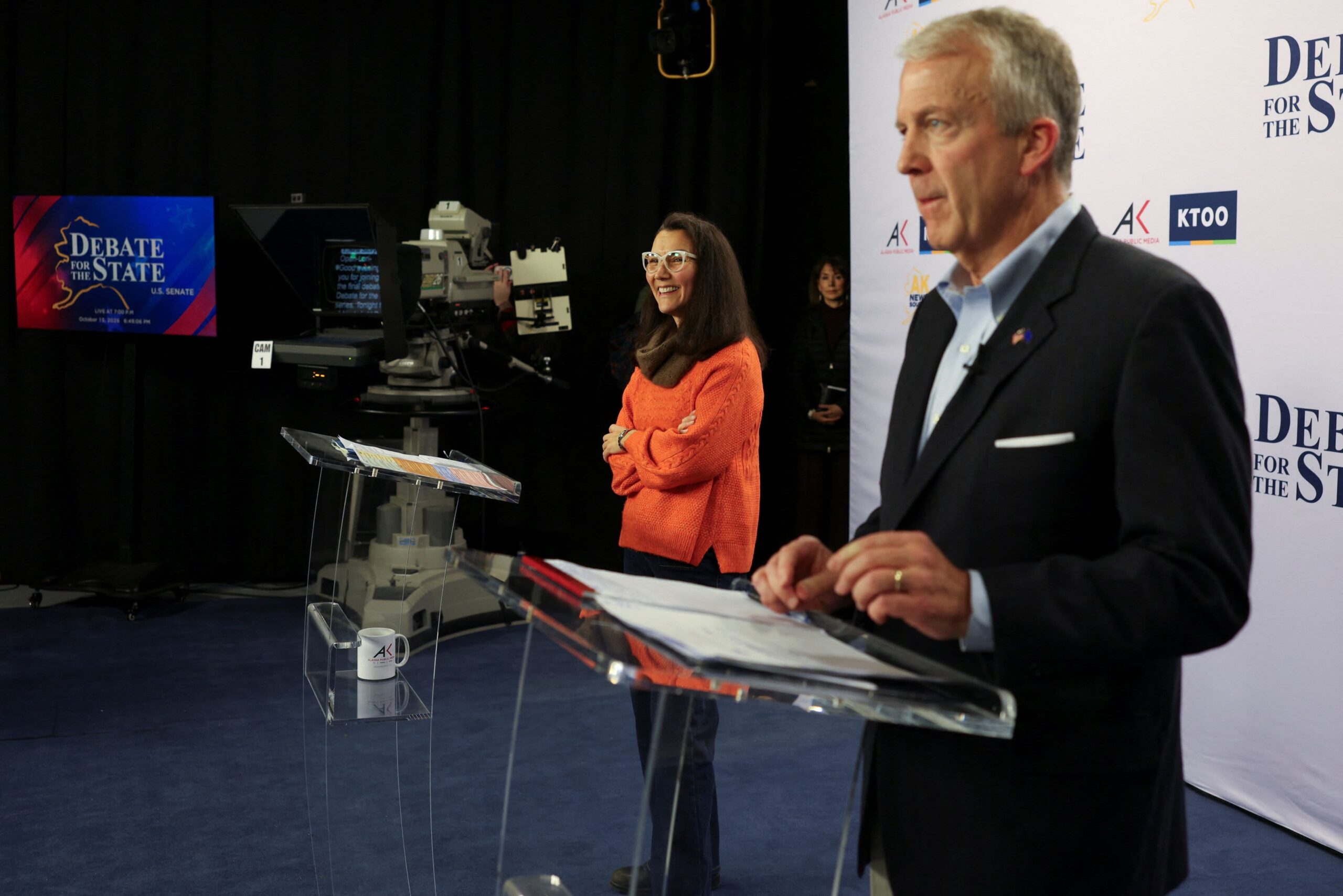
Republican U.S. Sen. Dan Sullivan and Democratic U.S. Senate candidate Mary Peltola participate in a debate in Anchorage, Alaska, Oct. 15, 2026.
Kerry Tasker | Reuters
A federal judge on Sunday dismissed the Department of Justice‘s extraordinary lawsuit seeking to delay certification of the Alaska Senate election if incumbent Republican Dan Sullivan loses, citing possible voter confusion from another candidate with his name on the ballot.
The ruling came two days before Election Day and two days after the U.S. Attorney for Alaska said ongoing criminal and civil investigations into non-incumbent Dan J. Sullivan’s decision to run for the Senate.
The campaign of Democratic nominee Mary Peltola, state election officials and outside advocacy groups had asked Judge Sharon Gleason to dismiss the DOJ’s lawsuit in U.S. District Court in Anchorage.
The Department of Justice quickly filed a notice of its intention to appeal the decision to the 9th Circuit U.S. Court of Appeals.
Peltola is locked in a tight contest with Sen. Dan Sullivan, whose winner will be determined by a ranked-choice system.
The outcome of the race is one of several contests that determine which party has a Senate majority, where Republicans currently hold a narrow lead.
Neither the other Sullivan nor the fourth candidate on the ballot, Gerald Heikes, is considered a contender.
But voters who rank them as a first choice could swing the outcome by ranking Peltola or Sen. Sullivan second.
Peltola’s campaign has been accused of encouraging retired schoolteacher Dan Sullivan to run for the Senate against the incumbent Sen. Dan S. Sullivan and Peltola.
Her campaign has denied those claims.
“No sham investigation or baseless lawsuit from a weaponized Department of Justice is going to stop Alaskans from electing Mary on November 3rd so she can lower costs for Alaska’s working families,” Peltola’s campaign said in a statement after Sunday’s ruling.
“Alaskans will choose their next U.S. Senator – not Dan Sullivan or his DC allies,” the campaign said.
In her 20-page decision, Gleason did not resolve whether another Sullivan had been recruited to confuse voters.
Instead, she said the federal government had failed to establish that it had legal standing to file a civil complaint to postpone certification of the election if Sen. Sullivan lost.
In that event, the DOJ wanted an investigation into voter intent and possible confusion from having two Dan Sullivans on the ballot.
“The absence of any explanation from the United States as to how its requested relief could redress its alleged injury while simultaneously maintaining the secrecy of the ballot is telling,” Gleason said in her ruling.
She noted that early voting in the state was already underway, and that ballots already cast have been commingled in a way that would prevent officials from linking individual ballots to voters.
This Oct. 29, 2026, photo shows a sample election ballot in Anchorage, Alaska.
Eloise Brethes | AFP | Getty Images
“More fundamentally, the United States provides no workable plan as to how it proposes to segregate ballots cast for Daniel J. Sullivan on Election Day and then conduct a court-ordered unspecified ‘investigation’ of those ballots in a manner that would preserve voter secrecy,” Gleason wrote.
The judge also cited a Supreme Court decision that established the so-called Purcell principle, which “strongly cautions” against courts altering election rules on the eve of election.
She noted that DOJ claimed it was not seeking to alter the “time, place or manner of Alaska’s election.”
But at the same time, Gleason said, the DOJ was asking her for an order “preventing the State
from certifying the election if certain circumstances occur; a court order requiring the State to segregate and preserve certain ballots; and a court order permitting the United States to conduct an investigation into the intent of those voters who cast ballots for Daniel J. Sullivan.”
“These requests certainly involve the time, place, and manner of Alaska’s election, which are the responsibilities of the State, not the executive branch of the federal government,” Gleason said.
The judge said she would not allow the DOJ to amend the lawsuit, which was revised last week to add a new legal claim under the Supremacy Clause of the U.S. Constitution to the first claim under the National Voter Registration Act. The amended complaint also added details of a New York Times article about the alleged recruitment of the second Sullivan.
“The Court finds that further amendment would be futile because this Court lacks the authority to order that certain ballots cast by Alaskans be segregated so that federal law enforcement officials can conduct an unspecified investigation of the voters who cast them,” Gleason said.
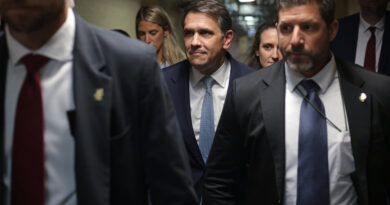
Dan J. Sullivan, a candidate in Alaska’s U.S. Senate race who shares his name with the incumbent seeking reelection, talks with a reporter in Petersburg, Alaska, July 3, 2026.
Becky Bohrer | AP
A DOJ spokesperson said in a statement, “The court dismissed the case on procedural grounds but did not dispute the argument of the United States that Daniel J. Sullivan (a/k/a Decoy Dan) entered the race as a frivolous candidate to confuse voters.”
“DOJ plans to file a notice of appeal,” the spokesperson said. “Alaskan voters deserve a fair election, not to be misled in an attempt to rig outcomes.”
The White House, when asked for comment, referred CNBC to the DOJ’s statement.
President Donald Trump has said he ordered the lawsuit, which was filed Oct. 22.
Trump argued that Peltola and other Democrats had recruited the former school teacher to run in hopes of confusing voters who wanted to cast their ballots for Sen. Sullivan.
The New York Times on Wednesday reported that Peltola campaign aides and DSCC aides had been involved in efforts to recruit the retiree for the race.
Peltola’s campaign and the Democratic Senatorial Campaign Committee have denied having any involvement in his campaign.
DSCC Executive Director Devan Barber said in a statement, “Today’s ruling is a victory for democracy and a clear message to Donald Trump and Senate Republicans: No one, no matter how powerful, can toss out free and fair elections just because they don’t like the result.”
“We will never stop fighting back against the shameful, brazen efforts from the Trump administration and their weaponized Department of Justice to subvert the U.S. Senate race in Alaska, or any other election as voters reject Republicans at ballot boxes across the country – and we are confident Alaska voters will elect Mary Peltola to the Senate,” Barber said.
Sen. Sullivan, in an interview on CNN before Gleason issued her ruling, said he would accept the election results if he lost.
But he also blasted Peltola’s campaign and the DSCC.
“Recognizing they couldn’t run on their record, so they had to cheat,” Sullivan said. “I think a lot of Alaskans, even Democrats, are thinking she is not fit for office; she’s continually lying to the Alaskan people, and I guarantee you she’s lying right now.”
Alaska election officials have pointed to steps they took to avoid voter confusion on the ballots for the race.
The ballots list Sen. Sullivan as “Dan S. Sullivan,” with the words “incumbent” and “registered Republican” next to his name.
The other Sullivan is listed as “Daniel J. Sullivan,” with no other words next to his name.
Election officials originally had blocked the retired teacher from the primary ballot. But a state judge allowed him on the ballot. Alaska’s Supreme Court upheld that ruling.
Source – CNBC