
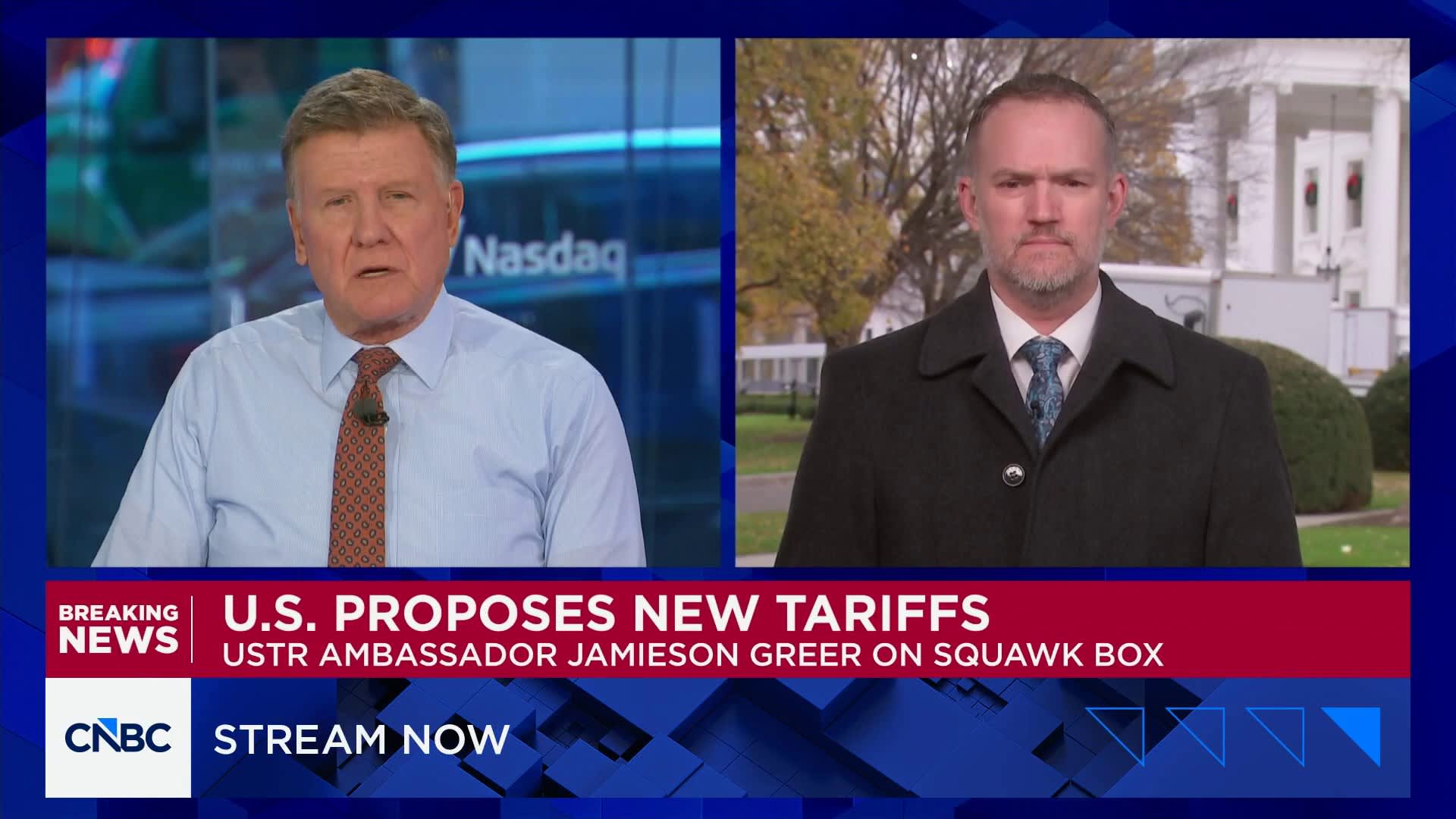
U.S. proposes new tariffs on 14 trading partners, including China and the EU

The U.S. is preparing new tariffs on 14 economies, including China, the EU, Japan and India, following investigations into what the Trump administration says are excess manufacturing practices that disadvantage U.S. commerce.
The administration launched those and other trade investigations in March, weeks after the Supreme Court unraveled a major piece of President Donald Trump‘s tariff-heavy economic policy by striking down his “liberation day” duties. Trump has since been accused by critics of his tariffs of trying to revive the canceled duties using other legal authorities.
The latest action targets foreign economies that create, sustain or contribute to structural excess capacity and production in manufacturing sectors that the U.S. finds unreasonable and burdensome or restrictive to its commerce, a senior U.S. official told reporters Tuesday evening.
The new tariffs are “targeted,” not blanket rates, and will vary for each economy, and many will not exceed the rates established in previously reached trade deals, said the official, who spoke on condition of anonymity to discuss the forthcoming duties.
The rates, which mostly range from 15% to 20%, are “not really additive” and generally will not stack on top of existing duties, U.S. Trade Representative Jamieson Greer told CNBC’s “Squawk Box” Wednesday morning.
“In effect, it’ll look more like a top up,” Greer said. “When it all nets out, it really will just top up a few percentage points.”
An exception is China, which faces a 20% rate under the new tariff policy, “so it will go up some,” Greer said. But at the same time, both countries are moving to remove tariffs on some of each other’s goods in what Greer called “stability-generating activity through this action.”
U.S. Trade Representative Jamieson Greer speaking to CNBC on Nov. 25th, 2026.
CNBC
The senior U.S. official said Tuesday that the 20% rate will come on top of the so-called forced technology transfer-related tariffs of roughly 25%, which were implemented during Trump’s first presidential term. U.S. tariffs on Chinese goods will therefore reach about 45%, give or take for different goods, the official said.
Average U.S. tariffs rates on Chinese goods stood at about 36.5% as of July, according to the Congressional Research Service.
Greer also said on CNBC that the new policy likely will not take effect for months.
“We’ve talked to our trading partners about this. They know what we’re proposing,” he said. “I think a lot of this is baked in, and I don’t think any of these would actually take effect earlier than a couple months from now.”
The administration says the tariffs target what it calls “overcapacity” — excess industrial production, often supported by government subsidies, that allows cheaper goods to flood global markets and undercut U.S. producers.
China has disputed the allegations. “The so-called ‘overcapacity’ does not really exist,” China’s foreign ministry said Wednesday before the official reports were released by the Office of the U.S. Trade Representative, according to Reuters.
The overcapacity levies are being imposed under Section 301 of the Trade Act of 1974. The Trump administration invoked the same statute to launch investigations into 60 economies over alleged forced-labor issues.
Those investigations, which also began in March, led to broad tariffs of 10% to 12.5% on goods from dozens of countries covering 99.4% of U.S. imports.
The Section 301 actions came weeks after the Supreme Court struck down the near-global tariffs that Trump had enacted under the International Emergency Economic Powers Act.
Shortly after the court’s ruling, Trump invoked Section 122 of the Trade Act of 1974 to impose a 10% global tariff. That tariff expired after 150 days, and was immediately replaced with the forced-labor-related duties.
An ongoing lawsuit accuses the Trump administration of citing forced-labor issues as a “pretext” in pursuit of reviving Trump’s worldwide tariff regime.
Source – Middle east monitor