

Turkiye seeking to carve out a niche role for itself in Libya

Turkiye’s policy toward Libya is one of the most interesting cases in its foreign policy, having undergone significant shifts since 2011. Through its new approach, Ankara seeks to establish a niche role for itself in Libya through both diplomacy and security.
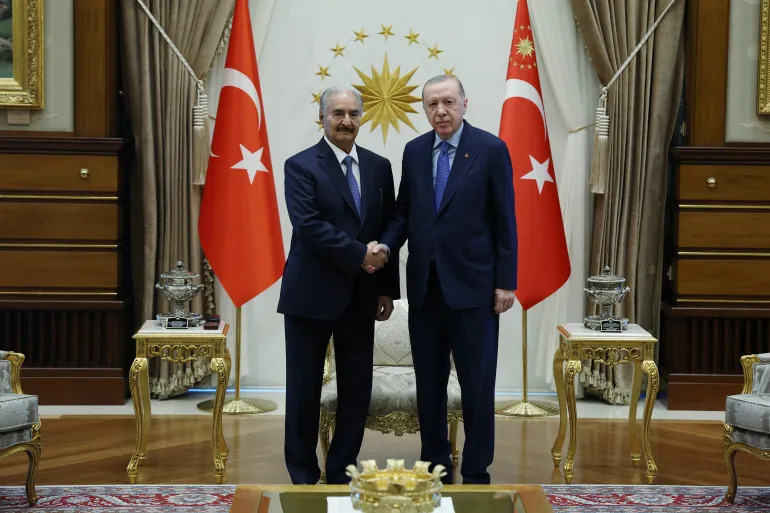
Khalifa Haftar, the leader of the Libyan National Army, which controls the eastern part of the country, this week met with Turkish President Recep Tayyip Erdogan in Ankara on his first official trip to the country. The visit marked a major thaw in Haftar’s relations with Ankara, which backed the Tripoli-based UN-recognized government against his eastern forces during the Libyan civil war.
Although details of the talks were not disclosed, images released from the visit offered some insights. Haftar was accompanied by his sons Saddam, Khaled and Belqasim, who hold key positions in Libya. Saddam, his likely successor, wrote in a Facebook post that the talks in Ankara marked “an important step” in building trust between the two sides and laid the groundwork for a new phase in relations with Turkiye. In early December, Erdogan is expected to pay his first trip to Libya since 2011.
Although Turkiye intervened in support of the Tripoli government when it came under siege from Haftar’s forces in 2019, Ankara has been seeking to deepen ties with both sides in the past few years. Ankara’s dialogue with Haftar’s administration followed a classic Turkish pattern: The “IDL” (intelligence-diplomatic-leadership) approach. The dialogue started with initial intelligence contacts, followed by diplomatic engagement and, finally, high-level leadership meetings.
Haftar’s visit to Ankara came a few days after Erdogan met with the Tripoli-based government’s prime minister
Dr. Sinem Cengiz
Last year marked a major shift in Turkiye’s Libya policy. In April 2025, Saddam, then the newly appointed deputy commander of the Libyan National Army, visited Ankara to discuss military cooperation. This was followed by the visit of Turkish intelligence chief Ibrahim Kalin to Benghazi in August 2025, his first trip there since 2011. That visit, which brought Haftar and Kalin together to discuss cooperation on intelligence and military issues, marked a major change in Tobruk-Ankara relations.
Turkiye already has military-military relations with the Tripoli-based government, given the security and military cooperation agreement they signed in 2019, but now a similar engagement is being pursued with Haftar. Since its intervention to stop Haftar’s offensive against Tripoli in 2019, Turkiye has maintained a strong military and political footprint in western Libya. The initial intelligence contact was followed by Turkish Foreign Minister Hakan Fidan’s diplomatic engagements in both eastern and western Libya, which gradually paved the way for this week’s Haftar-Erdogan meeting.
In October, Ankara assumed a new role in its approach toward Libya: mediator. In a two-track mechanism, Ankara hosted talks between representatives of Haftar’s administration and the Tripoli government, carving out a balancing role in order to maintain ties with both camps. Haftar’s visit to Ankara came a few days after Erdogan met with the Tripoli-based government’s prime minister, Abdulhamid Dbeibah, on the sidelines of the COP31 climate change conference in Antalya. Ankara has described this new policy toward the country as “One Libya,” supporting a unified approach and embracing partnership with both administrations.
In October, Ankara was also able to secure parliamentary approval in the Haftar-aligned legislature for a maritime treaty that recognizes Turkish rights in the Eastern Mediterranean. In 2019, Turkiye signed a memorandum of understanding on maritime relations with the then-Tripoli government that was in favor of Ankara’s maritime claims in the Eastern Mediterranean. However, given the frosty relations with Ankara at that time, the Libyan National Army rejected the deal. Last month’s approval reverses that position and strengthens Turkiye’s hand against other stakeholders in the Eastern Mediterranean.
Ankara’s regional rapprochement policy paved the way for the normalization of relations with the Haftar administration
Dr. Sinem Cengiz
While bridging the political divide is one of the key drivers of Turkiye’s Libya policy, other considerations are linked to its strategic interests in the Eastern Mediterranean and its relations with regional actors. Not long ago, Haftar was described as a “mercenary” by Erdogan himself. However, Ankara’s regional rapprochement policy paved the way for the normalization of relations with the Haftar administration. Thus, the regional normalization trend that began in 2021 was another key factor behind the shift in Turkiye’s Libya policy. Within this context, Saddam’s visit this week to Qatar, a key Turkish ally and regional player involved in mediation efforts, is noteworthy.
The latest developments came just a few days after a Ukrainian attack on two Russian ships near Benghazi that reportedly killed two Libyan soldiers. Turkiye condemned the Ukrainian attack in a show of solidarity for Libya’s sovereignty but also out of concern that Russian-Ukrainian tensions may spill over into Libya. Haftar was backed by Russia during its 2019 offensive.
Turkiye’s approach of building close ties with the authorities in both the east and west of Libya aims to narrow the room for maneuver for other actors in the country. Ankara aims to carve out a niche role for itself that combines diplomacy with security. While gatekeeping the diplomatic channels between the two sides, it also wants to be the key actor in any future security arrangements in the country.
Besides the ratification of the maritime deal, the rapprochement with Haftar is significant for Ankara for other reasons, including the potential for arms sales, increased political leverage and opportunities for Turkish companies in construction, infrastructure and energy. For Haftar, building relations with the Turkish political and security elite is significant not only for his own political ambitions but also for positioning Saddam as his potential successor. Therefore, Haftar’s visit and Erdogan’s upcoming trip extend far beyond the normalization of relations between two former rivals — it also reflects both political and economic calculations.
X: @SinemCngz
Source – Arab News