
Family of Black man shot by Aurora police intends to sue
The family of Rajon Belt-Stubblefield served notice Monday to the city of Aurora that they intend to file a lawsuit in connection with the August shooting death of the unarmed Black man.
Belt-Stubblefield was 37 when he was shot and killed by an Aurora police officer during an Aug. 30 traffic stop, and his then 18-year-old son witnessed the shooting. A notice of claim — a legal step necessary before suing the city — was filed on behalf of Belt-Stubblefield’s family and a second notice was filed on behalf of his son, Zion Murphy.
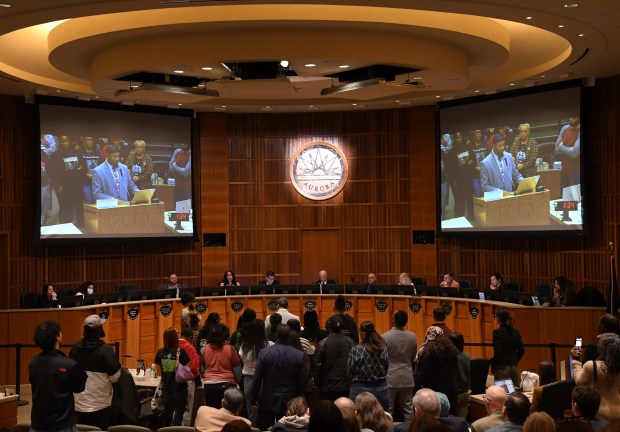
The family, along with their lawyer Milo Schwab, held a news conference to announce the filing and then attended the Aurora City Council meeting where they spoke about a lack of transparency surrounding the shooting and a need for accountability for officer Matthew Neely, who fired the fatal shots. Neely’s name had not been released by the police department.
“No child should ever have to witness that,” said Erica Murphy, Zion Murphy’s mother. “No child should have to carry the trauma for the rest of their life. Rajon was more than a headline. He was more than a police report. He was a father. He was loved. He mattered.”
On the night of the shooting, Neely tried to pull over Belt-Stubblefield for speeding and a possible DUI near East Sixth Avenue and Sable Boulevard. Zion Murphy was driving behind his father in another car.

Belt-Stubblefield fled and then rear-ended one car before crossing a median and hitting a second vehicle. He was armed but tossed a handgun into the grass before walking toward the officer, Aurora police Chief Todd Chamberlain said at the time.
Belt-Stubblefield ignored orders to stop and raised his hands, and Neely punched him in an attempt to de-escalate the situation, according to Chamberlain’s account in the days after the shooting. Belt-Stubblefield raised his fist and repeatedly asked if the officer was “ready for this,” Chamberlain said.
The officer shot Belt-Stubblefield as he continued to move toward him, backing Neely into the street, Chamberlain said.
Belt-Stubblefield died at the scene.
But the notices of claim filed by Schwab offer a different perspective on what happened.
Neely pointed his weapon at Belt-Stubblefield as soon as he exited his wrecked car, and Belt-Stubblefield asked the officer not to shoot him as he tossed his gun into the grass. Neely tried to grab Belt-Stubblefield by the neck and take him to the ground, but the officer is the one who fell, according to the notice of claim. Belt-Stubblefield did not take aggressive action and tried to walk away.
Neely then followed Belt-Stubblefield, shoved him in the back and then as Belt-Stubblefield turned to speak to his son Neely “suckerpunched Mr. Belt-Stubblefield in the back of the head, causing Mr. Belt-Stubblefield to put his fists up to protect his head,” the notice of claim stated.
Neely backed into the street with his gun and fired three times. The first two shots struck Belt-Stubblefield in the chest, and he stopped and looked at Neely. Neely then fired the third shot into Belton-Stubblefield’s head, killing him at the scene, the notice of claim said.
Schwab said the city has not communicated with the family in the six months since the shooting, and the officer has not been disciplined for his actions.
“We’ve given it six months,” he said. “We’re done waiting.”
The shooting drew national attention, leading prominent civil rights attorney Ben Crump to visit with Belt-Stubblefield’s widow and to condemn the fatal shooting.
Aurora has been in the spotlight for police brutality multiple times in the past decade, most notably for the 2019 killing of Elijah McClain, an unarmed 23-year-old Black man who died during a violent arrest even though he had not committed a crime. McClain’s name became a rallying cry in the wake of Black Lives Matter protests in 2020.
Two Aurora paramedics and a police officer were convicted for their roles in McClain’s death. Two others were acquitted, and the city paid $15 million to McClain’s parents to settle a civil rights lawsuit.
Colorado Attorney General Phil Weiser placed the department under a consent decree after McClain’s death after his investigation found a pattern of racially biased police and excessive force within the department.
In 2015, Aurora paid a $2.6 million settlement — the largest in city history at the time — to the family of Naeschylus Carter-Vinzant, an unarmed Black man who shot by a city police officer. Officers were trying to serve an arrest warrant after Carter-Vinzant had removed a monitoring bracelet from his ankle. That settlement also came with an agreement from the city to improve police oversight and to improve community relations.
The family of Kilyn Lewis, an unarmed Black man killed by Aurora police in 2024, sued the city in May for wrongful death. That case is pending.
Source – Indonesia News


