
Inside the rise of Gen Z’s nostalgia-fueled plush-toy craze as they delay adulthood
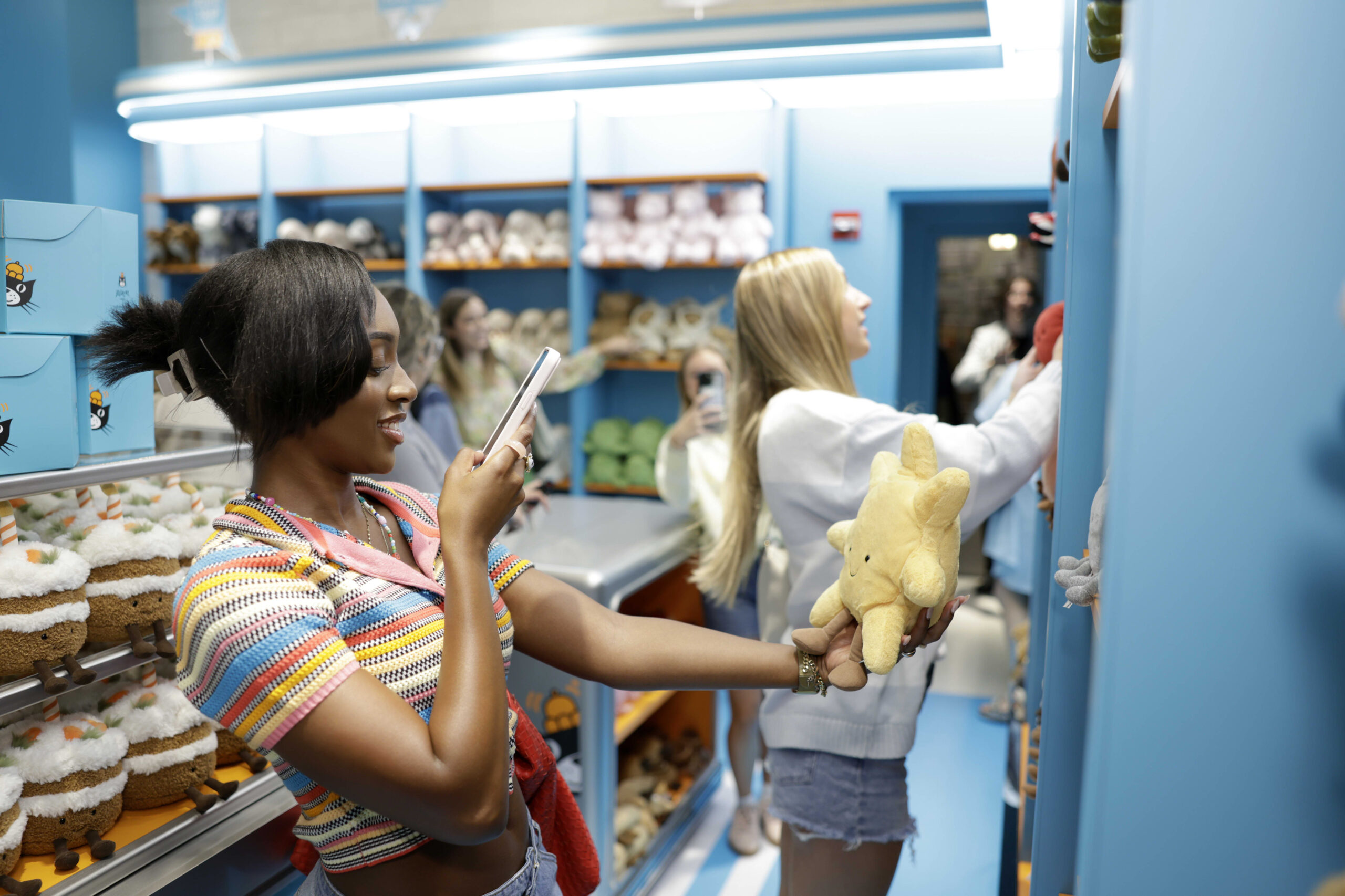
A guest poses for a photograph during the Jellycat Road Trip to Joy at Nordstrom Michigan Avenue in Chicago, Illinois.
Jeff Schear / Stringer/ Getty Images
Christmas is just around the corner and if you’re stuck on what to gift your Gen Z family members, a cuddly plush toy might be the answer this year.
2025 has proved that toys are not just for kids, as more young adults show off extensive collections of plushies. Experts say it signals a longing for community and a return to childhood.
The popularity has been driven by a manic craze for Labubu dolls — collectable toys produced by Chinese toy company Pop Mart — as well as for soft toys, also known as “Jellies,” designed by British brand Jellycat.
Brightly coloured stuffed animals and wide-eyed dolls can be seen lined up on walls or falling out of overstuffed shelves, in videos posted by Gen Z on TikTok.
The platform — which has become a barometer for Gen Z trends — is currently home to millions of videos showing young adults obsessed with plushies.
Videos range from building a “Labubu wall,” to hacks on finding authentic Labubus, or a five-rack shelf dedicated to displaying Jellies.
“It’s the biggest year we’ve ever seen of adults buying toys,” Melissa Symonds, U.K. toys director at global consumer insights firm Circana, told CNBC Make It in an interview.
“Adults of all ages do buy into toys, but it’s primarily the younger, the Gen Z people, that are really driving this strong growth that we’ve had in the last few years,” Symonds said.
Labubu dolls are on display at a Pop Mart store in Shanghai, China.
Vcg | Visual China Group | Getty Images
In fact, a recent Circana report found that 43% of U.K. adults bought a toy for themselves or another adult this year, and that rises to 76% for Gen Z shoppers between the ages of 18 to 34-years-old.
Across toy genres, plushies are the fourth most popular category for adults, with games and puzzles ranking top, followed by building sets like LEGO, and action figures coming in at third place, according to data from Circanca shared with CNBC.
It’s a similar story across the pond, with sales of licensed toys increasing by 18% for U.S. adults over the age of 18 in the first half of the year, per Circana.
“There’s almost this irony that when you’re a kid, you can’t wait to grow up, but then when you’re an adult, you realize that being a kid was the best time of your life.”
Melissa Symonds
Executive director of toys at Circana
Symonds explained that businesses are tapping into what’s called the “joy economy” in which consumers seek out comfort and nostalgia in products and experiences, especially when faced with economic or political pressures.
“The economy, the wars, everything is really depressing and serious, whereas toys just bring a little bit of joy back into life,” Symonds said.
Pop Mart and Jellycat have benefited from that trend. Pop Mart posted a near 400% surge in net profit in the first half of the year, and its revenue jumped 204.4% year on year to 13.88 billion yuan ($1.93 billion).
In 2024, roughly $423 million of the company’s global revenue came from Labubu dolls alone, Pop Mart previously told CNBC Make It.

Meanwhile, Jellycat saw its revenue rise 66% to £333 million in 2024, up from £200 million in 2023. Its profit before tax more than doubled to £139 million, up from £67 million the prior year.
“Seeing the response across multiple generations to our new characters has been wonderful,” Jellycat’s CEO Arnaud Meysselle said in a statement to CNBC.
“It’s been amazing to meet so many adults discovering Jellycat for the first time at our recent experience launches in Beijing, Seoul, and Los Angeles — and to welcome many others into our online communities,” Meysselle said.
‘Peter Pan effect’
Guests attend the Jellycat X Selfridges Amuseables Bag launch in London, England.
Dave Benett | Dave Benett Collection | Getty Images
Fans of Jellycat, Labubu, and plushies in general span from corporate workers to military personnel who tout the benefits the toys have on their mental health on TikTok, as they grapple with increasingly stressful adult lives.
Circana’s Symonds said that this is a symptom of the “Peter Pan effect” which refers to a psychological syndrome where adults struggle to grow up and take on responsibilities.
“There’s almost this irony that when you’re a kid, you can’t wait to grow up, but then when you’re an adult, you realize that being a kid was the best time of your life,” she said.
“There’s a bit of that Peter Pan effect where they [Gen Z consumers] don’t want to grow up, but I think it’s just holding on to that joy element that brings them happiness.”
Gen Z adults have had it fairly rough as a generation as many say they were priced out of the adulthood they were promised. Economic and geopolitical turmoil has disrupted their lives, footage of war replays on their social media feeds every day, and the cost of living continues to skyrocket.
Some of the conflicts they’ve seen through their adult lives include the Russian invasion of Ukraine in 2022, to the Israel-Hamas war.
And to top it all off, rising inflation means their buying power decreases every day with economic milestones like buying a house or starting a family feeling out of reach.

Many Gen Z are instead “doom spending” to fill the gap. This refers to a phenomenon where people splash out on small luxuries like travel, designer goods, or even expensive toys because they know they might never be able to afford bigger milestones like owning a home or even children.
Delaying parenthood also means Gen Z have more disposable income to spend on small luxuries.
“I think some of it might be because they’re [Gen Z] choosing to have kids slightly older, so they’ve got a slightly longer period of time where they have money coming in, but don’t necessarily have to spend it on schools or lunch boxes, so they’re choosing to spend it on themselves to bring themselves some happiness,” Symonds said.
‘Part of the community’
Alongside economic woes, Gen Z have also struggled with loneliness and for some, buying and collecting toys can help them feel like they’re part of a community.
Some 85% of British Gen Z reported experiencing feelings of loneliness, according to a Hinge survey that polled 2,000 Gen Z adults in the U.K. in March. More than half of low-income young adults experienced severe loneliness, according to the research.
Jellycat’s Meysselle explained that the brand has looked to create a community for its fans from launching Instagram and TikTok accounts in 2022, both of which have racked up over two million followers since.
Jellycat Fish & Chips Experience at Selfridges, London.
Tim Charles
It’s also invested in themed pop-up experiences that fans can visit in person, from Jellycat Fish & Chips in Selfridges in London, to Jellycat Patisserie in Galeries Lafayette in Paris, and Jellycat Diner in FAO Schwarz in New York.
Around 80% of fans that turned up to Jellycat’s Space Experience in Seoul that was launched in November, were in their 20s and 30s — the largest percentage of adults at a Jellycat experience so far.
Selfridges’ toy buyer Joe Evans told CNBC Make It that Jellycat is its fastest-selling toy brand, and, in the past two years, there’s been “a meteoric rise” in Gen Z and millennial customers who want to “feel like they’re part of a community and collect,” toys.
“When you purchase a Jellycat, you feel like you’re part of a community, you feel like you’re part of something, there are a lot of groups online that talk, and people race each other for the best and the newest product,” he added.
Source – Middle east monitor


