
Iran war live updates: Trump says U.S. to offer insurance for Gulf shipping and escort tankers
American embassy in Beirut closes
The U.S. Embassy in Beirut, Lebanon, closed, citing “ongoing regional tensions.”
The closure, announced in a post by the diplomatic mission’s X account, came on the heels of the closure of two other American embassies in the region, in Saudi Arabia and Kuwait.
The U.S. Embassy in Riyadh, Saudi Arabia, was hit by a drone attack.
— Dan Mangan
13 Min Ago
Israeli airline El Al prepares repatriation flights to Tel Aviv
Israeli airline El Al said it is “fully prepared” to start repatriation flights to Tel Aviv as early as Wednesday night as airspace gradually reopens in the region.
“The airline will bring customers back home in an organized and gradual manner from more than 20 gateways, while giving priority to exceptional humanitarian and medical cases,” the carrier said.
— Leslie Josephs
19 Min Ago
Trump orders U.S. to provide risk insurance for Gulf maritime trade, says Navy will escort tankers through Strait of Hormuz
A cargo ship is pictured off coast city of Fujairah, in the Strait of Hormuz in the northern Emirate on Feb. 25, 2026.
Giuseppe Cacace | AFP | Getty Images
Trump said that he has ordered the U.S. Development Finance Corporation to provide “political risk insurance and guarantees for the Financial Security of ALL Maritime Trade, especially Energy, traveling through the Gulf.”
“This will be available to all Shipping Lines,” Trump wrote in a Truth Social post.
“If necessary, the United States Navy will begin escorting tankers through the Strait of Hormuz, as soon as possible,” he wrote.
“No matter what, the United States will ensure the FREE FLOW of ENERGY to the WORLD,” he added. “The United States’ ECONOMIC and MILITARY MIGHT is the GREATEST ON EARTH — More actions to come.”
— Kevin Breuninger
28 Min Ago
Amazon tells Middle East staffers to work from home
Amazon logo on brick office building facade with windows, San Francisco, California, Aug. 29, 2025.
Smith Collection | Gado | Archive Photos | Getty Images
Amazon is instructing all of its corporate employees in the Middle East to work remotely and “follow local government guidelines,” as the company responds to the widening conflict in the region.
“The safety of our employees and partners remains our top priority, and we are working closely with local teams and local authorities to ensure they are supported,” an Amazon spokesperson said in a statement.
Amazon has grown its presence in the Middle East over the past few years, opening corporate offices in the United Arab Emirates, Saudi Arabia, Jordan, Kuwait, Egypt, Turkey and Israel. It also operates warehouses and data centers throughout the region, and “quick commerce outlets” in the UAE to fulfill 15-minute deliveries.
The company’s retail and cloud businesses have been disrupted in the Middle East amid escalating instability in recent days. Two data centers in the UAE were hit by drones, and another site in Bahrain was damaged by nearby drone strikes. The facilities remain offline.
It’s unclear how many people Amazon employs in the Middle East. Amazon is the world’s second-largest private employer, behind Walmart, according to Fortune’s Global 500 list. The company had 1.57 million staffers globally as of the end of December.
— Annie Palmer
1 Hour Ago
Satellite images show damage to Iranian presidential complex and Khamenei residence
Vantor satellite images show the before-and-after damage to the presidential complex and the residence of Iran’s former supreme leader, Ayatollah Ali Khamenei.
Before: Presidential complex
Vantor satellite image shows a closer view of the presidential complex in Tehran before airstrikes.
2026 Vantor | Maxar | Getty Images
After: Presidential complex
Vantor satellite image shows damaged presidential complex with visible smoke plumes after the airstrikes.
2026 Vantor | Maxar | Getty Images
Before: Presidential complex and Khamenei residence
Vantor satellite image shows an overview of the presidential complex and Khameini residence in Tehran prior to airstrikes, before the event in Presidential Complex And Khomeini Residence.
2026 Vantor | Maxar | Getty Images
After: Presidential complex and Khamenei residence
Vantor satellite image shows an overview of the presidential complex and Khameini residence showing smoke damage after airstrikes in Tehran.
2026 Vantor | Maxar | Getty Images
— Adam Jeffery
2 Hours Ago
Anthropic’s AI models being used to support U.S. military’s operations in Iran: Source
Anthropic co-founder and CEO Dario Amodei speaks on an artificial intelligence panel during Inbound 2025 Powered by HubSpot at Moscone Center on in San Francisco, Sept. 4, 2025.
Chance Yeh | Getty Images Entertainment | Getty Images
Anthropic’s artificial intelligence models are being used to support the U.S. military’s operations in Iran, even after the company was blacklisted by the Trump administration, according to a source familiar with the matter, who asked not to be named because the details are confidential.
Defense Secretary Pete Hegseth designated Anthropic a “supply chain risk to national security” on Friday after weeks of tense negotiations about how its AI models can be used. Trump also directed every federal agency in the U.S. to “immediately cease” all use of Anthropic’s technology.
A representative for Anthropic declined to comment on whether its models are being used in the war in Iran. The company said in a statement Friday that it plans to challenge the supply chain risk designation in court.
Anthropic CEO Dario Amodei said Thursday that the company’s “strong preference” is to continue working with the Defense Department. But even as the agency moves away from its technology, Amodei suggested Anthropic would continue to cooperate with ongoing operations.
“Should the Department choose to offboard Anthropic, we will work to enable a smooth transition to another provider, avoiding any disruption to ongoing military planning, operations, or other critical missions,” Amodei wrote. “Our models will be available on the expansive terms we have proposed for as long as required.”
— Ashley Capoot and Kate Rooney
2 Hours Ago
Hegseth ‘100%’ backs Trump denial that Israel pulled U.S. into Iran war
Secretary of Defense Pete Hegseth backed Trump’s remark that the U.S. “might have forced Israel’s hand” in initiating war in Iran, rather than the other way around.
“This is 100% correct,” Hegseth said in an X post responding to Trump’s comments from the Oval Office denying that Israeli Prime Minister Benjamin Netanyahu pulled the U.S. into the war.
Questions about Israel’s influence in the U.S. decision intensified after Secretary of State Marco Rubio said Monday, “We knew that there was going to be an Israeli action. We knew that that would precipitate an attack against American forces, and we knew that if we didn’t preemptively go after them before they launched those attacks, we would suffer higher casualties.”
Later that day, House Speaker Mike Johnson, R-La., said that Israel “was determined to act in their own defense” with or without the U.S. because they faced what they deemed to be an “existential threat” from Iran.
Intelligence showed that “if Israel fired upon Iran … then they would have immediately retaliated against U.S. personnel and assets,” Johnson said, adding that the consequence of waiting “could have been devastating.”
Trump, however, said Tuesday that he believed Iran was “going to attack first, and I didn’t want that to happen.”
— Kevin Breuninger
2 Hours Ago
Virgin Atlantic plans UAE, Saudi Arabia flights; carriers eye Oman to repatriate customers
Virgin Atlantic planes are seen at Heathrow airport. London, Britain, May 5, 2020.
Toby Melville | Reuters
Virgin Atlantic is planning to resume service between London Heathrow and Dubai, United Arab Emirates, and Riyadh, Saudi Arabia, on Tuesday, with returns scheduled for Wednesday. However, the carrier warned customers that there could be last-minute changes to routings and schedules.
Airlines have canceled about 20,000 flights to and from the region since the U.S. and Israel attacked Iran on Saturday, stranding or displacing hundreds of thousands of travelers.
The airline is avoiding Iraqi airspace and has told travelers that flights to India and the Maldives could be longer due to rerouting.
Separately, British Airways and Lufthansa said Tuesday they are planning repatriation flights for citizens from Oman, where airspace is open.
— Leslie Josephs
2 Hours Ago
Trump administration’s topsy-turvy narrative on the war

Trump said combat will continue in Iran until U.S. “objectives” are complete. Those objectives and the justification for the war have remained fluid more than 48 hours into the conflict.
Trump and his proxies have not been aligned on their narrative, leading to confusion about how Trump and his advisors are defining the endgame for the escalating conflict. The stated justification since the attack began Saturday has whipsawed between preventing Iran from obtaining a nuclear weapon, deposing the Iranian regime that brutally represses dissent, stopping an imminent attack from Iran on U.S. interests and following Israel’s lead.
The muddied messaging underscores a broader question: Is Trump pursuing a single military objective or full-blown regime change? And the dynamic has incensed Democrats, who have largely come out against the war, and led a handful of Republicans to raise questions.
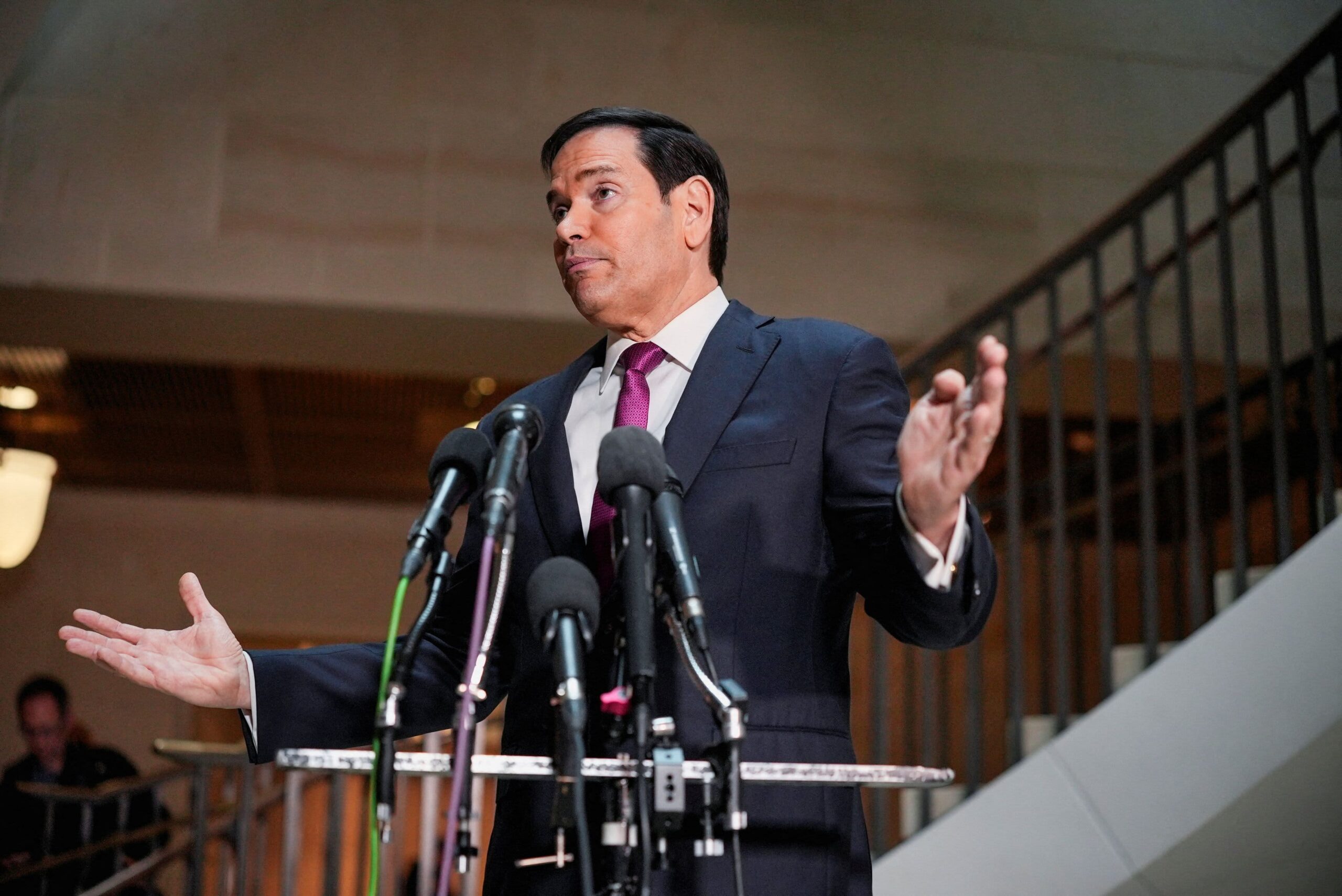
Secretary of State Marco Rubio talks to reporters ahead of briefing the Congressional âGang of Eightâ on U.S. strikes on Iran, at the U.S. Capitol in Washington, DC on March 2, 2026.
Anadolu | Anadolu | Getty Images
“We have seen the goals for this operation change now, I believe, four or five times,” Sen. Mark Warner, D-Va., the top Democrat on the Senate Intelligence Committee, told reporters Monday after meeting with Secretary of State Marco Rubio. “It was about the Iranian nuclear capacity, a few days later it was about taking out the ballistic missiles, it was then — in the president’s own words — about regime change … and now we hear it’s about sinking the Iranian fleet.”
“I’m not sure which of those goals, if met, means that we’re at an endgame,” Warner said.
Analysts say it’s possible the U.S. could be pursuing both regime change and a functional disarmament of Iran — a long-term goal of U.S. administrations over decades. They’re looking at what targets the U.S. and Israel are both striking to determine motives. There is also a possibility that the U.S. and Israel are pursuing both objectives separately.
— Garrett Downs
2 Hours Ago
Trump says Iran war may bring higher oil prices ‘for a little while,’ but predicts they will drop
A motorist refuels a vehicle at a gas station in Englewood, Ohio, US, on Tuesday, Oct. 21, 2025.
Kyle Grillot | Bloomberg | Getty Images
Trump suggested that rising oil prices would not be enough for him to abandon the war with Iran.
“I have never had more compliments on something I did,” Trump said at the White House.
“So if we have a little high oil prices for a little while, but as soon as this ends those prices are going to drop, I believe, lower than even before,” he said.
Oil prices have surged amid the military conflict in the Middle East, and as Iran said it would close the Strait of Hormuz, a vital transit route for crude oil that ferries an average of 14.5 million barrels each day.
The energy spike has boosted Treasury yields, as investors fear the price jump could exacerbate inflation and influence the Federal Reserve as it weighs further interest rate cuts.
— Kevin Breuninger
3 Hours Ago
Trump says most people U.S. had in mind to take over Iran ‘are dead’
U.S. President Donald Trump speaks as he meets with German Chancellor Friedrich Merz in the Oval Office at the White House in Washington, D.C., U.S., March 3, 2026.
Jonathan Ernst | Reuters
Trump said that the U.S. would like to have the next leader of Iran be someone who will bring the country “back for the people,” but acknowledges that a person who fits that bill may now be dead because of the war.
“Most of the people we had in mind are dead,” Trump said at the White House. “We had some in mind from that group that is dead. And now we have another group. They may be dead, also based on reports.”
“So I guess you have a third wave coming in, pretty sure we’re not going to know anybody,” he said.
Asked by a reporter if the Iranian crown prince, Reza Pahlavi, who lives in exile in the U.S., is an option, Trump replied, “Some people like him. We haven’t been thinking too much about that.”
“It would seem to me that somebody from within might be more appropriate,” Trump said.
— Dan Mangan
3 Hours Ago
European stocks sink 3% as Middle East conflict intensifies
European stocks finished sharply lower on Tuesday, as the intensifying conflict in the Middle East continued to weigh on global investor sentiment.
The pan-European Stoxx 600 ended Tuesday’s session 3.2% lower, extending Monday’s losses that saw the index close down 1.6%.
All major regional bourses traded in negative territory, with Germany’s DAX and Italy’s FTSE MIB notching the sharpest declines.
— Chloe Taylor, Hugh Leask and Holly Ellyatt
3 Hours Ago
Analysis: What former U.S. intelligence officials are watching as war with Iran unfolds
The national flag of Iran flies in the wind as debris lies scattered in the aftermath of an Israeli and U.S. strike on a police station, amid the U.S.-Israeli conflict with Iran, in Tehran, Iran, March 3, 2026.
Majid Asgaripour | Via Reuters
Former U.S. intelligence officials are watching what’s happening in the Mideast region, but are also focusing on what’s not happening, which can sometimes be just as telling.
Ted Singer, the Central Intelligence Agency’s former head of Middle East operations and five-time station chief, tells CNBC he’s watching the Houthis — the Islamist political group in Yemen, which has been backed by Iran. To Singer, it’s telling that the Houthis have so far remained inactive in response to the U.S. and Israeli attacks.
“They haven’t yet gotten into the fray,” Singer said. “They’ve probably made the calculation that they don’t want to violate their truce with Saudi Arabia because they have to live with that forever. And they may believe Iran as we know it is done forever — or at least for the foreseeable near future.”
Singer is also watching shifting U.S. explanations for the war, and points out that vagueness offers decision-making latitude for the Trump administration.
“The goal and acceptable end are in the eye of the beholder, Trumpian,” Singer said. “Trump will probably settle on some layer of the current regime — a la Delcy Rodriguez — once they say the magic words of no nukes, not ballistic missiles pointed at Israel and no help to proxies.”
Another former CIA station chief in the region tells CNBC he is watching Iran’s conventional army leadership, known as Atresh, as a bellwether for the conflict. The U.S. will need Artesh “to side with the people and not just stay neutral,” this former CIA station chief said.
“The jury’s still out on Artesh, Israelis and CIA should be engaging them,” the former CIA station chief added.
— Eamon Javers
Correction: The post was revised to attribute the following quote to a former CIA station chief: “The jury’s still out on Artesh, Israelis and CIA should be engaging them.”
3 Hours Ago
Trump denies Israel pulled U.S. into war: ‘If anything, I might have forced Israel’s hand’

Trump denied accusations that Israel effectively dragged the U.S. into war with Iran by planning an initial strike on Tehran’s regime that could have led to retaliatory attacks against America.
Asked at the White House if Israel forced his hand to launch the strikes, Trump said, “No, I might’ve forced their hand.”
A day earlier, Secretary of State Marco Rubio said, “We knew that there was going to be an Israeli action. We knew that that would precipitate an attack against American forces, and we knew that if we didn’t preemptively go after them before they launched those attacks, we would suffer higher casualties.”
The remarks drew major scrutiny and criticism, even from some on the right who regularly side with Trump.
But Trump said Tuesday: “We were having negotiations with these lunatics, and it was my opinion that they were going to attack first. They were going to attack. If we didn’t do it, they were going to attack first. I felt strongly about that.”
“And based on the way the negotiation was going, I think they were going to attack first, and I didn’t want that to happen,” Trump said. “So if anything, I might have forced Israel’s hand.”
— Kevin Breuninger
3 Hours Ago
CNBC bureau chief: Iranian missiles forced my Dubai flight to turn around twice
About 30 minutes before landing, passengers on a 3½-hour Emirates flight to Dubai received an alarming update from their captain: The plane would have to turn around because Iran had fired missiles at the UAE.
CNBC Middle East bureau chief Emma Graham was on that repatriation flight, a half-full Airbus A380 that had taken off from Mumbai, India.
About 15 minutes after the initial announcement — and after the plane turned around — the captain said that the airspace had reopened and the plane was clear to land in Dubai.
— Emma Graham and Kevin Breuninger
4 Hours Ago
Lufthansa plans a repatriation flight from Oman
Lufthansa Airbus A340 passenger aircraft as seen landing at Eindhoven Airport EIN during a rare charter flight, arriving from Athens, Greece.
Nicholas Economou | Nurphoto | Getty Images
Lufthansa said it’s sending a wide-body jet to Muscat, Oman, “on behalf of the German government” to repatriate German citizens from the region either Wednesday or Thursday evening, with service in other parts of the region suspended.
Lufthansa’s Airbus A340-300s seat 279 passengers. The German airline group said that its service from Dubai and Abu Dhabi in the United Arab Emirates remains suspended until at least Friday and flights to and from Tel Aviv, Israel, Beirut, Amman, Jordan, Erbil, Iraq, and Tehran, Iran, until March 8.
Larnaca, Cyprus, service is suspended until at least Friday; the company will avoid that airspace after a drone attack hit a British military base there.
“As soon as the situation on the ground and the associated airspace closures allow, we will decide on additional flights from the region in order to be able to offer our guests a return journey as soon as possible,” the company said.
— Leslie Josephs
4 Hours Ago
How the Iran war is hitting the global supply chain
Iran’s closure of the Strait of Hormuz is halting the global supply chain, and the impacts could worsen as the U.S.-Iran war continues.
The strait is a vital artery for the global oil trade, with about 31% of all seaborne crude flows passing through it in 2025.
With shipping costs set to inflate due to war surcharges and fuel surcharges, here’s what consumers should expect:

— Frank Holland
5 Hours Ago
U.S. gas prices poised to rise to $3.35 per gallon on average: Analyst
Average U.S. gas prices are poised to climb as high as $3.35 per gallon, based on their current trajectory, according to Patrick de Haan, head of petroleum analysis at GasBuddy.
“Any further changes in markets will change this, but if everything held still, that’s where we’d likely be,” de Haan said on X.
Diesel would rise closer to $4.25 to $4.45 per gallon, he added.
Rising gas prices — which on Monday saw their biggest single-day jump in four years, according to de Haan — follow the surging prices of crude oil and natural gas. Those fluctuations coincided with Iran reportedly closing the Strait of Hormuz and threatening to attack any tankers trying to pass through the key route.
GasBuddy’s live-ticking average before 11 a.m. ET on Tuesday showed U.S. gas prices nearing $3.10 per gallon.
— Kevin Breuninger
5 Hours Ago
Alphabet employees press management to reject potential Pentagon deal for Gemini AI
Cfoto | Future Publishing | Getty Images
Tech workers at Alphabet are pushing for clearer limits on military AI, as tensions rise across Silicon Valley following U.S. strikes on Iran and the Pentagon’s move to blacklist Anthropic’s models.
A wave of open letters circulating across the industry argues that recent events have heightened concerns over how frontier artificial intelligence could be used in warfare, surveillance and other high-risk government operations.
The biggest pressure point is now Google, with Alphabet reportedly in talks with the Pentagon about bringing its Gemini models into classified environments, reviving a deeply sensitive fight inside the company over military work.
More than 100 Google employees working on AI reportedly signed an internal letter last week urging leaders to adopt the same red lines as Anthropic.
Jeff Dean, DeepMind’s chief scientist who received the memo, appeared to align with at least part of that concern, writing on X that mass surveillance violates the Fourth Amendment, chills free expression, and is vulnerable to political or discriminatory abuse.
— MacKenzie Sigalos and Jennifer Elias
5 Hours Ago
U.S. closes embassies in Saudi Arabia and Kuwait
The US embassy headquarters in Riyadh is pictured on March 3, 2026, after it was hit by drone strikes earlier. Iran hit back at industrial and diplomatic targets across the Middle East on March 3, with Washington warning its citizens to evacuate the entire region.
– | Afp | Getty Images
The U.S. closed its embassies in Saudi Arabia and Kuwait.
The X account of the U.S. Embassy in Riyadh, Saudi Arabia, cited a drone “attack on the facility” for the closure there.
“Due to ongoing regional tensions, the U.S. Embassy in Kuwait will be closed until further notice,” that embassy’s X account said.
“We have canceled all regular and emergency consular appointments. We will communicate when the embassy returns to normal operations.”
— Dan Mangan
5 Hours Ago
Dow plummets 1,000 points
The Dow Jones Industrial Average continued to sink lower Tuesday morning, falling more than 1,000 points, or 2.1%, and heading for its worst trading day since April 2025.
— Kevin Breuninger
5 Hours Ago
U.S. Embassy in Jerusalem can’t help Americans leave Israel after State Dept. urges departure
The U.S. Embassy in Jerusalem said overnight that it “is not in a position at this time to evacuate or directly assist Americans in departing Israel.”
The message came hours after the U.S. State Department on Monday urged Americans to “DEPART NOW” from 14 countries in the Middle East — including Israel — “due to serious safety risks.”
The Jerusalem embassy’s official X account said that Israel’s Tourism Ministry is running shuttles to the Taba Border Crossing between Israel and Egypt, but that it “cannot make any recommendation (for or against)” that option.
“If you choose to avail yourself of this option to depart, the U.S. government cannot guarantee your safety,” the embassy said.
— Kevin Breuninger
6 Hours Ago
Stocks plunge at market open as traders react to Iran war
6 Hours Ago
Travel chaos continues with more than 18,000 cancellations since Saturday
Passengers sit waiting for news about flights at Terminal 4 at London Heathrow Airport in west London on March 1, 2026, as flights are severely disrupted following the US and Israel’s strikes on Iran.
Justin Tallis | Afp | Getty Images
More than 1 million people are caught in travel chaos as another 1,900 flights were canceled in and out of the Middle East on Tuesday, according to aviation data firm Cirium.
Displaced customers and crews include travelers who were using major Middle East hubs like Dubai in the United Arab Emirates, one of the biggest airport hubs in the world, to get to other destinations as far flung as Paris and Beijing.
— Leslie Josephs
6 Hours Ago
Gas prices see largest single-day jump in 4 years: Analyst
Gas prices around $5.00 a gallon at a 76 station at the corner of Beach Boulevard and Lampson Avenue in Stanton, CA, on Monday, March 2, 2026.
Jeff Gritchen | Medianews Group | Getty Images
The national average price of gasoline in the U.S. rose 12 cents per gallon on Monday, marking the largest spike in four years, GasBuddy’s chief petroleum analyst, Patrick de Haan, said on X.
GasBuddy’s live-ticking average before 9 a.m. ET on Tuesday showed U.S. gas prices above $3.08 per gallon.
De Haan said in another X post that he does not currently foresee gas prices hitting $4 per gallon “anytime soon, even based on poor outcomes with the current situation.”
“If thinking changes, I’ll post here,” he added.
— Kevin Breuninger
7 Hours Ago
UAE says it has the right to defend itself
UAE’s Minister of State for International Cooperation Reem Al Hashimy arrives at the second day of the BRICS Foreign Ministers meeting in Rio de Janeiro, Brazil, on April 29, 2025. (Photo by Pablo PORCIUNCULA / AFP) (Photo by PABLO PORCIUNCULA/AFP via Getty Images)
Pablo Porciuncula | Afp | Getty Images
The United Arab Emirates reaffirmed its right to self-defense on Tuesday, stressing that any threat to Emirati sovereignty represents a threat to the wider Gulf.
Reem Al Hashimy, the country’s minister of cooperation, said in a news conference in the capital Abu Dhabi, that the Gulf Cooperation Council operates as “one system,” and that an attack on any member state endangers the entire region.
All six members of the GCC, the Arab monarchies of Kuwait, Bahrain, Saudi Arabia, Qatar, Oman and the United Arab Emirates, have all come under fire from Iranian missiles and drones since Saturday.
Hashimy added that the UAE will not accept actions that compromise its sovereignty or security, warning that such escalations carry global consequences. Hashimy emphasized that the country maintains the full right to defend itself and stands firmly with GCC partners in responding to regional threats.
— Emma Graham
8 Hours Ago
Ukraine’s Zelenskyy says his country will help the UAE protect lives
Ukraine’s President Volodymyr Zelenskyy speaks during a press briefing following phone calls with U.S. President Donald Trump, amid Russia’s attack on Ukraine, in Kyiv, Ukraine, May 19, 2025.
Thomas Peter | Reuters
Ukraine’s president, Volodymyr Zelenskyy said his country will explore how to help the United Arab Emirates protect itself from attacks by Iran.
The UAE has been one of several countries across the Gulf that have come under missile and drone fire as Iran retaliates following the U.S. and Israeli strikes which started on Saturday.
Amazon Web Services said late Monday two of its data centers in the United Arab Emirates and a facility in Bahrain were damaged by drone strikes, taking the facilities offline.
Other facilities and infrastructure in the UAE have also been damaged.
Zelenskyy said he discussed the situation with UAE President Mohamed bin Zayed Al Nahyan.
“I expressed my condolences over the lives lost as a result of Iran’s insane strikes,” Zelenskyy said in a post on X.
“The President noted that the Iranian regime is targeting not only military facilities but virtually everything – residential buildings, shopping malls, even mosques,” Zelenskyy said.
“We discussed how we can help in this situation and support the protection of lives. It was agreed that our teams will work on this. Protecting lives is a shared priority for everyone in the world.”
— Azhar Sukri
9 Hours Ago
Israel says it has ‘dismantled’ Iranian regime’s leadership compound
The Israeli military said it has “dismantled” the Iranian regime’s leadership compound and killed the leaders there.
“This command headquarters was one of the most heavily secured assets in Iran. The compound that housed the regime’s most senior forum was struck by the IAF overnight using precise intelligence,” the Israel Defense Forces said in a post on X.
— Azhar Sukri
9 Hours Ago
Dollar rises as global risk appetite plummets
The U.S. dollar edged higher on Tuesday morning, building on gains seen the previous day as investors weighed the impact and potential duration of the U.S.-Iran war.
As the war entered its fourth day, the U.S. dollar index — which measures the greenback against a basket of major currencies — was almost 1% higher.

Dollar index
A broad de-dollarization trend has dented the value of the dollar over the past year, with the dollar index losing more than 7% over the last 12 months. Historically, the dollar — the world’s reserve currency — has been widely viewed as a stable asset.
“A market that had jumped into the ‘de-dollarisation’ trend in substantial ways can get caught out quickly when you reintroduce a terms-of-trade shock,” strategists at Mizuho EMEA said in a note this morning.
“You start to see a scramble for USD liquidity — not because people suddenly love the dollar, but because in stress the world still settles in USD, funds in USD, hedges in USD and ultimately buys energy in USD (with the US now a net-exporter too),” they added. “We’ve spent the past year watching FX correlations fly out the window thanks to the de-dollarization narrative, well this is the kind of moment that snaps it all back.”
— Chloe Taylor
10 Hours Ago
Putin doing his best to defuse Middle East tensions, Kremlin says
Russian President Vladimir Putin (C) enters the hall during the meeting with Iranian President Masoud Pezeshkian (not pictured), October 11, 2024, in Ashgabat, Turkmenistan.
Contributor | Getty Images News | Getty Images
Russian President Vladimir Putin is trying to de-escalate tensions in the Middle East as much as possible, the Kremlin said Tuesday.
“Putin will certainly make every effort to facilitate at least a minor easing of tensions,” Putin’s press secretary, Dmitry Peskov, said in comments reported by state news agency TASS.
“In this regard, we discussed with virtually all of our interlocutors yesterday that Putin will convey his deep concern regarding the strikes on their infrastructure to our colleagues in Iran, taking advantage of the dialogue we maintain with the Iranian leadership,” Peskov added.
It’s the first public comment the Kremlin has made on the U.S. and Israel’s attacks on Iran, a close economic and military ally of Moscow’s, after four days of relentless strikes on the Islamic Republic’s leadership and military sites.
Analysts told CNBC that Iran’s most powerful allies, Russia and China, were unlikely to come to the regime’s rescue, despite their “strategic partnerships.”
Read more here: Why Iran should not count on allies Russia and China to come to its aid
— Holly Ellyatt
10 Hours Ago
Oil prices spike
Dado Ruvic | Reuters
Oil prices rose further on Tuesday, as missile strikes across the Middle East continued and Iran reportedly closed the Strait of Hormuz, a shipping route critical to the global transportation of oil and other goods.
At 5 a.m. ET, global benchmark Brent crude oil futures jumped 5.4% to $81.96, touching a 1-year high after gaining more than 7% on Monday.
Brent crude futures
Front-month West Texas Intermediate oil futures were 5.8% higher at around $75.55, touching on their highest prices since mid-2025.
— Chloe Taylor
10 Hours Ago
Oil supertanker rates hit all-time high as Iran pledges to close the Strait of Hormuz
Naval units from Iran and Russia carry out to simulation of rescue a hijacked vessel during the joint naval drills held at the Port of Bandar Abbas near the Strait of Hormuz in Hormozgan, Iran on February 19, 2026.
Anadolu | Anadolu | Getty Images
The cost of hauling crude oil from the Middle East to China has soared to record levels as the U.S.-Israel war on Iran dramatically expands across the region.
The benchmark freight rate for the very large crude carriers, or VLCCs, used to ship 2 million barrels of oil from the Middle East to China climbed to $423,736 per day, data from LSEG showed on Monday, reflecting an increase of more than 94% from the previous session.
The dramatic move comes as shipping traffic grinds to an effective halt in the strategically vital Strait of Hormuz, amid fears of prolonged disruption to global trade.
For more, click here: Oil supertanker rates hit all-time high as Iran pledges to close the Strait of Hormuz.
— Sam Meredith
10 Hours Ago
European stocks sharply lower as Middle East conflict intensifies
European stocks traded sharply lower on Tuesday, as the intensifying conflict in the Middle East continued to weigh on global investor sentiment.
By 9:35 a.m. in London (4:35 a.m. ET), the pan-European Stoxx 600 was 2.7% lower, extending Monday’s steep losses that saw the index close down 1.6%.
Stoxx 600
On Tuesday morning, stocks across sectors were being sold off, with bank shares down 3.8%, insurance stocks, down 4.2%, and mining stocks, down 3.9%, leading losses. Even the Stoxx Aerospace and Defense index, home to the region’s biggest defense primes, shed 2.5% after ending Monday’s session in positive territory.
— Chloe Taylor
12 Hours Ago
Israeli military deploys additional forces to southern Lebanon
Plumes of smoke rise from the sites of Israeli airstrikes on the southern suburbs of Beirut on March 3, 2026. (Photo by IBRAHIM AMRO / AFP via Getty Images)
Ibrahim Amro | Afp | Getty Images
Israel’s military said on Tuesday it has deployed additional forces to southern Lebanon to protect Israeli residents near the border.
“The [Israel Defense Force] is working to create an additional layer of security for the residents of the north, through extensive attacks on the infrastructure of the terrorist organization Hezbollah, in order to thwart threats and prevent attempts to infiltrate the territory of the State of Israel,” a spokesman said in a statement.
Israeli Defense Minister Israel Katz said he and Prime Minister Benjamin Netanyahu had authorized the military to “advance and seize additional controlling areas in Lebanon to prevent firing on Israeli border settlements.”
In a statement on X, Katz said: “The [Israeli Defense Force] continues to operate with force against Hezbollah targets in Lebanon.”
— Azhar Sukri
14 Hours Ago
South Korean defense stocks see massive surge on Iran war
South Korean defense stocks pared gains, but still saw massive spikes on Tuesday after the country’s markets returned from a public holiday, as the Iran war fueled interest in defense names globally.
Heavyweight Hanwha Aerospace, which is South Korea’s largest defense manufacturer, saw shares surge nearly 25%, before moderating to about a 20% gain, while Korea Aerospace Industries gained more than 12%, but cut those to 3%.
Shares in air defense systems maker LIG Nex1 soared 30%, while electronic warfare systems manufacturer Victek and anti-aircraft missile components’ maker Firstec saw shares rise about 29.3% and 18%, respectively.
— Lim Hui Jie
14 Hours Ago
U.S. State Department orders evacuations of personnel from 3 more countries
The U.S. State Department has issued evacuation orders for nonemergency U.S. government personnel and their family members in Bahrain, Iraq and Jordan.
This was due to “security concerns,” with the State Department travel risk at level 3 for both Bahrain and Jordan, and at level 4 for Iraq, which indicates “do not travel.”
This comes after reported retaliatory strikes on U.S. bases in Bahrain and drone attacks on hotels housing U.S. troops by Iranian-backed militia in Iraq.
— Lim Hui Jie
14 Hours Ago
Supreme leader successor appointment ‘won’t take long’: Iran local media
FILE PHOTO: Iran’s Supreme Leader Ayatollah Ali Khamenei speaks in Tehran January 8, 2007.
Stringer Iran | Reuters
Iran’s ISNA news agency reported Tuesday that a member of the Assembly of Experts said appointing a successor to Ayatollah Ali Khamenei “won’t take long.”
Under Iran’s constitution, the supreme leader is appointed by the Assembly of Experts, an 88-member clerical body elected by the public every eight years. Candidates are first vetted by the Guardian Council, which tightly controls who can run.
When the position becomes vacant, the assembly convenes to deliberate and select a successor. The decision requires a simple majority vote.
In the interim, a provisional three-member leadership council assumes the supreme leader’s duties until a replacement is formally appointed.
— Lee Ying Shan
14 Hours Ago
Israel says it is conducting ‘simultaneous targeted’ strikes on Tehran and Beirut
This frame grab from AFPTV video footage taken on March 3, 2026 shows smoke rising into the air after Israeli strikes hit the outskirts of Beirut.
Kamal Mehanna | Afp | Getty Images
The Israeli military said it was conducting simultaneous targeted strikes against military targets in Tehran and Beirut, the authorities said in a X post on Tuesday.
The U.S. and Israeli war against Iran widened to Lebanon on Monday after the Lebanese Hezbollah militia fired missiles and drones into Israel.
— Anniek Bao
14 Hours Ago
The Strait of Hormuz is facing a blockade. These countries will be most impacted
ANKARA, TURKIYE – FEBRUARY 28: An infographic titled “Strait of Hormuz” created in Ankara, Turkiye on February 28, 2026. (Photo by Bedirhan Demirel/Anadolu via Getty Images)
Anadolu | Anadolu | Getty Images
The closure of the Strait of Hormuz by Iran is sending shock waves across global energy markets, with Asia expected to face the maximum pain.
A prolonged closure of the strait would likely lead to a further surge in oil prices, with some analysts seeing oil crossing $100 per barrel. Global benchmark Brent was last up 2.6% at around $80 per barrel —almost 10% higher since the conflict broke out.
About 20% of global liquefied natural gas exports that come from the Gulf are also at risk.
“In Asia, Thailand, India, Korea and the Philippines are the most vulnerable to higher oil prices, due to their high import dependence, while Malaysia would be a relative beneficiary since it is an energy exporter,” Nomura wrote in a note on Monday.
Read the full story here.
— Lee Ying Shan
15 Hours Ago
Trump touts ‘virtually unlimited’ U.S. munitions; UAE, Qatar deny weapons’ shortage
U.S. President Donald Trump speaks during a Medal of Honor ceremony in the East Room of the White House in Washington, United States, on March 02, 2026.
Kyle Mazza | Anadolu | Getty Images
President Donald Trump said Tuesday that the U.S. has a “virtually unlimited supply” of munitions as the war with Iran escalates.
He added that the stockpiles “at the medium and upper medium grade” have never been higher or better. It was not immediately clear what weapon grades Trump was referring to.
“Wars can be fought ‘forever,’ and very successfully, using just these supplies (which are better than other countries finest arms!),” Trump said in a post on Truth Social.
He added that “Much additional high grade weaponry is stored for us in outlying countries.”
Earlier, the United Arab Emirates and Qatar denied reports that their inventories of Patriot interceptor missiles were running low.
The two countries had requested assistance to counter aerial threats such as missiles and drones, Bloomberg reported, citing people familiar with the matter.
“These assertions are unfounded and misrepresent the UAE’s high level of preparedness, technological sophistication, and operational readiness,” the UAE Ministry of Foreign Affairs said in a statement.
Qatar’s International Media Office also said it is “well-stocked” with Patriot interceptor missiles.
— Victor Loh
17 Hours Ago
Amazon says drone strikes damaged three data centers in UAE and Bahrain
People walk past the logo of Amazon Web Services (AWS) at its exhibitor stall at the India Mobile Congress 2025 at Yashobhoomi, a convention and expo center in New Delhi, India, October 8, 2025.
Anushree Fadnavis | Reuters
Amazon‘s cloud computing unit confirmed three of its data centers in the Middle East were damaged by drone strikes, taking the facilities offline.
The company posted in an update to its Amazon Web Services health dashboard that two facilities in the United Arab Emirates were “directly struck” by drones on Sunday, causing extensive damage. A site in Bahrain was damaged due to a drone strike that occurred nearby.
“These strikes have caused structural damage, disrupted power delivery to our infrastructure, and in some cases required fire suppression activities that resulted in additional water damage,” the company wrote.
AWS encouraged customers to consider migrating workloads to other regions as the situation in the region remains “unpredictable.” It also said expected a prolonged recovery “given the nature of the physical damage involved.”
— Annie Palmer
19 Hours Ago
Trump says U.S. response to attack on its embassy will be revealed ‘soon’
U.S. President Donald Trump told NewsNation that details of Washington’s response to the attack on the U.S. Embassy in Riyadh, and for the deaths of American military personnel in the Iran conflict, would be revealed “soon,” according to a reporter from the outlet who shared excerpts of the interview on X on Monday.
Trump also said that boots on the ground won’t be necessary, according to the reporter’s post.
Saudi Arabia’s Defense Ministry said earlier that the U.S. Embassy had been hit by drones, causing a small fire and minor material damage.
— Vinay Dwivedi
19 Hours Ago
U.S. Embassy in Riyadh hit by drones, causing ‘limited fire,’ no injuries reported
The U.S. Embassy in Saudi Arabia’s capital city Riyadh was hit by two drones on Tuesday morning, according to the Middle Eastern country’s Defense Ministry.
The drone attack resulted in a “limited fire and minor material damage” to the building, according to the defense authority.
The U.S. Embassy in Saudi Arabia has issued a warning for people in Jeddah, Riyadh and Dhahran to hide in a shelter and limited nonessential travel to any military installations in the region.
“We recommend American citizens in the Kingdom to shelter in place immediately,” the embassy said in a post on X.
— Anniek Bao
Source – Middle east monitor


