
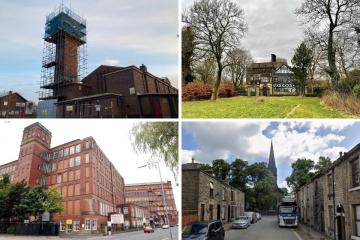
The historic buildings and areas of Bolton which are ‘at risk’

Historic England releases its ‘Heritage at Risk’ register every year, detailing the buildings and areas of interest whose heritage is said to be in danger.
There are 12 buildings and conservation areas which are said to be at risk in and around Bolton, with a range of issues and levels of severity.
Here are the 12 ‘at risk’ listings:
St Chad, Tonge Fold
St Chads Church (Image: Newsquest)
This modern Scandinavian-influenced church was built in 1937 and was designed by architect Richard Nickson.
The Grade II listed building was added to the Heritage at Risk Register in 2014.
The Church of England website says that it is now closed. Scaffolding can be seen on the tower and the building has been fenced off, with signs saying ‘danger unsafe structure’ and ‘beware falling debris’.
It is currently rated at grade C on the Heritage at Risk database, described as being in ‘slow decay’.
St James Church, Breightmet
Church of St James, Breightmet
This church on Roscow Avenue has been on the register for a number of years, and is currently rated as being of the highest priority, meaning it is at “immediate risk of further rapid deterioration or loss of fabric”.
But works are being done to improve the building, including making it watertight, which Revd Viv Masters thinks was a large reason why it was listed.
She said: “We are trying to address some of the problems, we have made the building watertight, and at the moment we are in the process of putting a toilet and kitchen in to make it more accessible.
“It is going well, the building is not as bad as some, the mission is going well and we are trying to do it bit by bit.
“Recently we had some of the joists replaced in the main part of the building.”
Birley Street conservation area, Astley Bridge
Birley Street (Image: Google Maps)
A lesser-known conservation area, Birley Street runs off Blackburn Road near to the Astley Bridge crossroads.
The attractive stone terraces were originally built as houses for mill workers, who would have plied their trade at Hesketh’s Mill, which used to sit on what is now the Asda supermarket.
But the street is considered at risk by Historic England, but at mid-level priority, with the trend stable or improving.
Ward councillor, John Walsh, said: “I think one of the problems is there have been a number of changes to windows and doors that are not compliant with the conservation area.”
He added that he believed the risk was more to do with the quality of the conservation area, with them being general issues and “not specific”.
Cllr Walsh added: “It is a historic part of Astley Bridge, they were mill cottages of the same vintage of the mill across the road, where Asda now stands.”
Hall i’ th’ Wood, Hall i’ th’ Wood
Hall i’th’Wood (Image: Keith Rylance)
The historic hall was only added to the register last year after it was forced to close its doors to the public in 2021 due to severe structural issues, including timber decay, damp, rot, and damage caused by vandalism.
Historic England rates it as being of the highest priority, with an “immediate risk of further rapid deterioration or loss of fabric”.
But plans are in place to restore Hall i’ th’ Wood and bring it back into use.
Bolton Council and Historic England are joining forces to restore the building and improve its energy efficiency, reducing operational costs and carbon emissions, once surveying has been completed.
Historic England has pledged more than £47,000 towards Bolton Council’s £95,000 for survey work to help restore it.
The Grade I listed site had been operating as a museum under the management of Bolton Council since 1900.
It is best known for being the place where Samuel Crompton invented the spinning mule, when he lived there.
Swan Lane Mill No 3, Great Lever
Swan Lane Mill
This mill was claimed at one time to have been the largest spinning mill in the world, under a single roof.
It has been included on the Heritage at Risk register for a number of years and is currently at medium priority, with it described as being in “slow decay”.
The impressive cotton mill, which dominates its surroundings, was designed in red brick by Stott and Sons of Oldham and dates back to 1914.
Summerhouse near Turton Tower, Turton
Turton Tower – a summerhouse near it is on the at risk register (Image: Newsquest)
A summerhouse to the east of the historic Turton Tower is listed on the at risk register.
The summerhouse, or lodge, was originally Grade II listed in 1984 and is said to be in “slow decay”, being of a mid-level priority.
It is just over the border into Blackburn with Darwen. The council announced in 2022 that it would sell the lodge, using the proceeds to upgrade the stables of Turton Tower.
It is not clear who now owns the building.
Read more: Which historic buildings in Bolton are at risk of being lost?
Read more: Historic Bolton hall which shut to the public is deemed ‘at risk’
Read more: Historic England names Bolton heritage buildings at risk of being lost
St Matthew’s Church, Little Lever
St Matthew’s Church, Little Lever
This Grade II listed church is rated as being in “slow decay” by Historic England, being at a medium priority.
Built in 1865 by architect EG Paley, it is described as a “well-designed” church with “fine quality fittings and glass”.
The church celebrated its 160th anniversary this year, though has been on the at risk register for a number of years.
Church of the Holy Trinity, Prestolee
Church of the Holy Trinity, Church Road, Prestolee (Image: Google)
This building on Church Road in the village of Prestolee is Grade II listed, having been built in 1863, designed by George Shaw of Uppermill.
Historic England describes it as a “finely detailed design” with an “impressive and unusual tower”. It adds that the interior has “rich fittings and glass”.
But Holy Trinity is described as being in “poor” condition and in “slow decay”, rated as mid-level priority.
Horwich Loco Works conservation area, Horwich
Horwich Loco Works
The collection of industrial buildings which formed the old locomotive works in Horwich is one of the most significant relics of the town’s industrial past.
It was the single biggest driver of the development of Horwich from a small village to the town it became, with it becoming a hub for the building and repairing of locomotives and other railway-related engineering work.
Historic England says the Loco Works is “deteriorating significantly”, but that it is of low priority, with the body “monitoring it as appropriate”.
Morris Homes’ Rivington Park development is in development at the old Loco Works site, as part of the wider £200m Rivington Chase development in Horwich and Blackrod.
Church of St Catherine, Horwich
Church of St Catherine, Horwich
This church was built in 1902 after the creation of Horwich Loco Works saw the surrounding population boom.
The congregation first met in a smaller building, used as a church and school. When it outgrew the building, St Catherine’s as it is now known was constructed by Frank Freeman.
Historic England describes it as now being in “slow decay”, but as a low priority, with a solution reportedly having been “agreed but not implemented”.
All Saints Ukrainian Church, town centre
All Saints Ukrainian Church
Plans were announced in October to turn this church into a “stylish restaurant” which would have kept many of the building’s old features.
But earlier this week the council confirmed that the developer had withdrawn its proposal.
The Heritage at Risk register says that the church, which was built from 1869 to 1871 and designed by architect George Edmund Street, is suffering “slow decay” and is of mid-level priority.
All Saints was Grade II listed in 1974.
Bolton Methodist Mission/Victoria Hall, town centre
Bolton Methodist Mission/Victoria Hall
This building, which was built at the turn of the 20th century by Bradshaw and Gass, celebrated its 125th anniversary this year, having been a cornerstone of the town’s cultural scene, hosting numerous events, concerts, and community gatherings.
Built as a Methodist central hall, Victoria Hall continues to serve as a place of worship while also being a popular venue for public events.
Historic England describes it as being in “slow decay”, but at mid-level priority.
Source – INDIA TV

