
Xi warns Trump on Taiwan at Beijing summit
BEIJING — China’s leader, Xi Jinping, delivered a warning on Taiwan to President Donald Trump as they met for a summit in Beijing on Thursday, saying that the issue, if handled poorly, could lead to conflict and “an extremely dangerous situation.”
The summit, the first US presidential visit to China in nearly a decade, could determine whether a detente between the two countries will continue — and what concessions, if any, either side is willing to make.
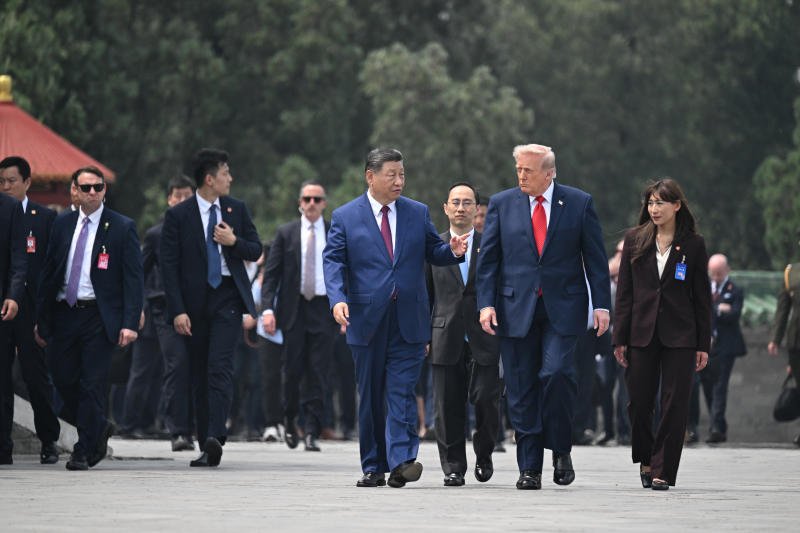
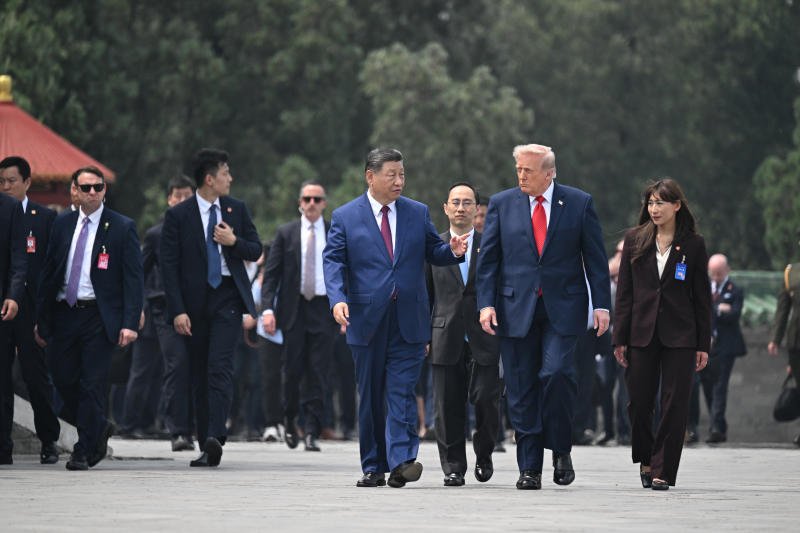
The leaders met in the Chinese capital in a ceremony laden with pageantry and pleasantries. Xi greeted Trump outside the Great Hall of the People before the two men walked together past an honour guard and rows of cheering children. As “The Star-Spangled Banner” played, a 21-gun salute echoed across Tiananmen Square.
The talks that followed lasted more than two hours. Xi called for the two countries to “be partners, not adversaries.” Trump said that he and Xi spoke on the phone to work out problems and called him “a great leader.”
Later, at an ornate state banquet in the Great Hall, Xi said in a toast: “The great rejuvenation of the Chinese nation and making America great again can go hand in hand.” Trump thanked Xi for a “magnificent welcome like none other” and formally invited Xi to visit the White House on Sept 24.
Beneath the warm words, Xi’s warning concerning Taiwan was a stark reminder of long-standing tensions. “If handled poorly, the two countries will collide or even clash, putting the entire US-China relationship in an extremely dangerous situation,” Xi said while referring to Taiwan, according to a readout from Xinhua, China’s official news agency.
Aside from Taiwan, Xi and Trump discussed trade, the Middle East, Ukraine and the Korean Peninsula, Xinhua said, without providing details.
The White House said both sides agreed in the talks Thursday that the Strait of Hormuz must remain open. The waterway, crucial for global energy supplies, has been effectively blocked since the US-Israeli war on Iran began in late February. “Both countries agreed that Iran can never have a nuclear weapon,” according to the US readout of the meeting.
The Chinese state media summary of the meeting did not mention Iran’s nuclear programme or the Strait of Hormuz, saying only that the Middle East was discussed.
The talks also covered fentanyl, securing market access for American companies in China, and increasing Chinese investments in American industries and purchases of US agricultural products, according to the White House.
The two men last met in October in South Korea, where they agreed to pause a trade war in which Beijing had threatened sweeping new export restrictions on rare earths in response to heavy US tariffs on Chinese goods. Xi decided at the time to postpone those measures for a year. A question looming over the summit is whether China will agree to an extension.
Here is what else we are covering:
— Ancient landmarks: Trump’s stops include some of China’s most politically and historically significant places, including the Temple of Heaven and the Great Hall of the People.
— Beef: China granted permission Thursday for hundreds of American slaughterhouses to resume beef shipments to China. The approval came before the start of the Trump-Xi talks.
— Human rights: Trump has said he will raise the case of Jimmy Lai, an imprisoned pro-democracy media mogul. Other human rights issues, including the repression of the Uyghurs, are unlikely to make the agenda.
This article originally appeared in The New York Times.
Source – Bangkok News


