Cabinet approves B7.7-billion relief package
Funds to ease impact of war-inflated costs for the poor, farmers, small businesses, transport operators and contractors
The cabinet has approved a 7.7-billion-baht economic relief package to support vulnerable groups, businesses, the transport sector and farmers in response to the economic impact of the ongoing conflict in the Middle East.
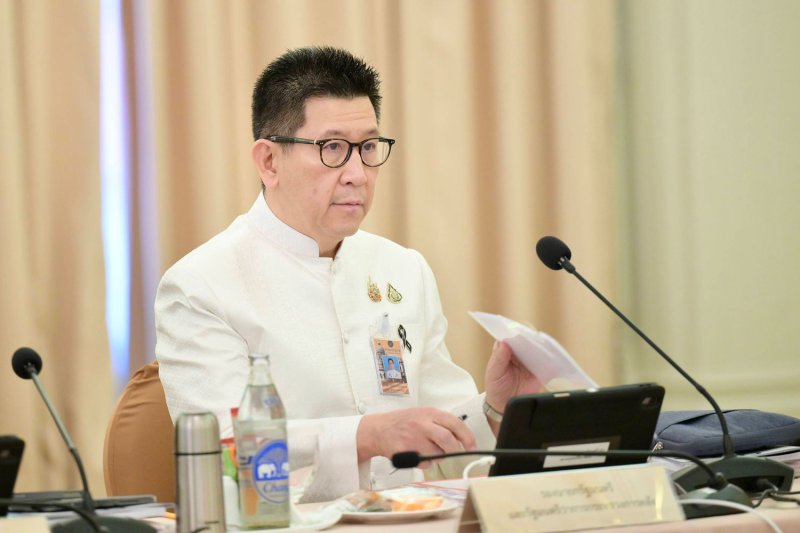
Speaking after a special cabinet meeting on Saturday at Government House, Finance Minister Ekniti Nitithanprapas said ministers had endorsed the use of funds from various sources, mainly the central budget, to mitigate risks from the conflict, which could trigger slower economic growth alongside rising inflation, or stagflation, if not addressed promptly.
The measures are designed to ease the cost of living for vulnerable groups, the transport sector and farmers. As well, they will support structural adjustment by encouraging a transition to cleaner energy, while strengthening liquidity for businesses and upstream agricultural producers in the supply chain.
Of the total, 6.02 billion baht will be allocated by the Ministry of Finance for vulnerable individuals and households. This includes topping up state welfare cards for 13.22 million holders by increasing the monthly allowance for essential goods from 300 to 400 baht. The top-up will apply for the period from April 13 to May 12, said Mr Ekniti, also a deputy prime minister.
The Government Savings Bank (GSB), meanwhile, will budget 5 billion baht for a soft-loan scheme, offering funds to financial institutions at an annual interest rate of just 0.01%.
EV and solar panel funds
Recipients in turn will lend the funds to support public access to financing for energy transition measures, such as purchasing electric vehicles (EVs) or installing solar panels, with a lending cap of 2 million baht per borrower over five years. Applications will be open until March 31, 2027.
The Government Housing Bank (GHB) will continue to offer concessional loans for energy-efficient housing, including programmes with starting interest rates of 2.20% per year and fixed rates of 2.69% for the first two years, as well as solar rooftop loans of up to 300,000 baht, said Mr Ekniti.
The Bank for Agriculture and Agricultural Cooperatives will introduce a 30-billion-baht co-payment loan programme for farmers, offering loans of up to 100,000 baht per borrower at 6% annual interest, with the government subsidising half of the rate.
For small and medium sized enterprises, the finance ministry and the GSB will provide 100 billion baht in soft loans, alongside additional financing from the SME Bank, to support the shift towards green businesses. The Export-Import Bank of Thailand will also introduce special insurance premium rates to assist exporters.
Help for contractors
Mr Ekniti said contractors engaged in government projects who are affected by the conflict in the Middle East will be allowed to terminate contracts without being blacklisted as project defaulters, with performance guarantees returned.
Those who have already signed contracts and suffered impacts may renegotiate terms, while agencies are advised to exercise discretion for projects not yet under way.
The cabinet also approved adjustments to reference prices for construction projects, reflecting diesel prices in the range of 51 to 70 baht per litre to better align with current market conditions.
As well, 2.06 billion baht has been approved for fuel subsidies for the transport sector over 42 days, from April 20 to May 31. The support will cover various groups, including truck operators, motorcycle taxi drivers, public vans and minibuses, interprovincial buses, metered taxis and non-regular transport services.
Funding will also be allocated to the state-owned bus operator The Transport Company to help reduce travel costs during the Songkran holiday period from April 6 to 19.
Mr Ekniti said Prime Minister Anutin Charnvirakul has instructed key agencies to expedite budget preparation while cutting non-essential expenditure, such as overseas study trips and training, reducing energy consumption in government offices and expanding work-from-from home arrangements to curb costs.
“These measures are designed to assist the public, entrepreneurs, vulnerable groups, the transport sector and farmers in easing the impact of the Middle East conflict,” said Mr Ekniti.
“This is a global crisis that has triggered an energy shock and carries the risk of escalating into a broader commodity and price crisis.
“We understand this situation may have long-term effects. The measures are therefore not only aimed at short-term relief, but also at preparing the public and businesses to adjust over the longer term.”
Source – Bangkok News