
Canada invited to become EU’s first ‘associate member’ as Trump trade war intensifies
(From L) Canada’s Prime Minister Mark Carney, EU Parliament President Roberta Metsola and European Commission President Ursula von der Leyen arrive for a speech during European Commission President’s annual State of the Union address at a plenary session of the European Parliament in Strasbourg, eastern France on September 16, 2026.
Jean-christophe Verhaegen | Afp | Getty Images
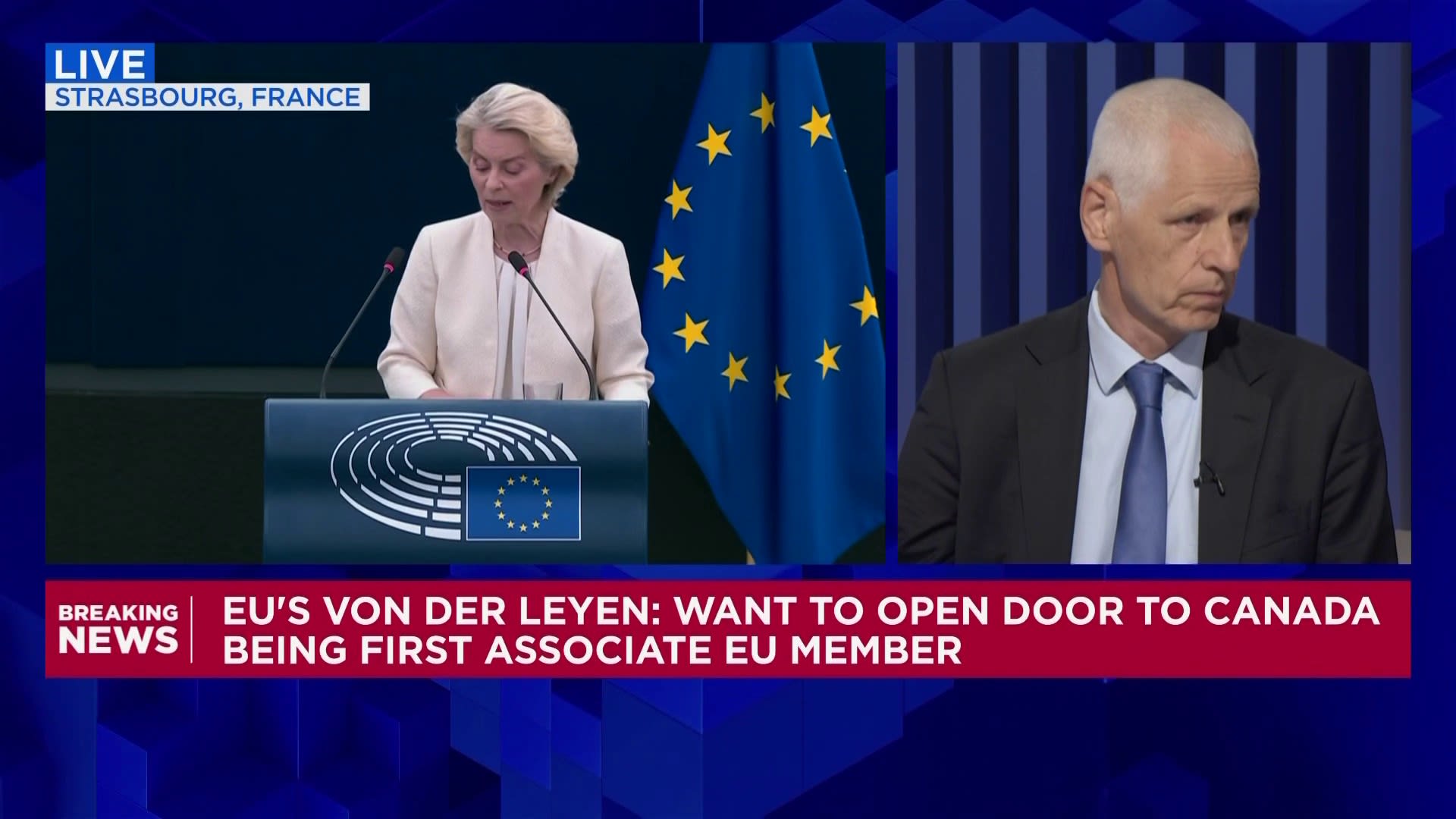
European Commission President Ursula von der Leyen on Wednesday said the European Union is opening the door for Canada to become the first associate member of the 27-nation bloc.
The announcement marks a significant change in EU policy and signals a major deepening of ties between Brussels and Ottawa.
Speaking in her annual state of the European Union address in Strasbourg, France, the EU chief said the bloc wants to bring the relationship with Canada “to the highest level possible.”
“And, dear Mark, I said we must urgently reimagine our partnerships so I would like to work with you on opening the door for Canada to being the first associate member of the European Union,” Von der Leyen said.
Canadian Prime Minister Mark Carney, who was in attendance for the speech and is due to address EU lawmakers on Thursday, had previously said Ottawa was keen to pursue a “unique security and economic alliance” with Europe, but not full membership.
Canada is currently locked in a bitter trade war with the U.S. and has pledged to match President Donald Trump‘s tariffs dollar for dollar.
Von der Leyen said the EU and Canada “see the world with the same eyes” and pledged to work together on issues such as AI, climate change, geopolitics and Arctic security.
The EU and Canada already have a free trade agreement, one that eliminated 99% of all tariff lines when it provisionally came into force in 2017. The pact is known as the EU-Canada Comprehensive Economic and Trade Agreement, or CETA.
“We will move from CETA to an alliance for the future, to create a common prosperity and economic security space,” Von der Leyen said.

The EU has previously been reluctant to entertain the prospect of flexible membership categories, notably when German Chancellor Friedrich Merz pushed for the EU to consider associate membership for Ukraine earlier in the year.
Asked whether Von der Leyen’s push to embrace Canada as the EU’s first associate member was history in the making, Berenberg chief economist Holger Schmieding said: “I think this is a big step, indeed.”
“Europe is trying to openly form new partnerships or deepen partnerships with all countries in the world that are sort of like-minded,” Schmieding told CNBC’s “Squawk Box Europe” on Wednesday.
“It is not necessarily against the U.S., but it is clearly in favor of making us less dependent on the U.S. and less dependent on China, and that deeper partnership with other countries, like-minded democracies, is actually something we see in the economic re-arm,” he added.
European Commission President Ursula von der Leyen delivers a speech during her annual State of the Union address at a plenary session of the European Parliament in Strasbourg, eastern France on September 16, 2026.
Jean-christophe Verhaegen | Afp | Getty Images
In early June, Finnish President Alexander Stubb outlined his vision for a much larger European Union, saying the bloc should “think big” to project power on the global stage. As part of this, Stubb said the EU might consider increasing its membership to 40 states and named Canada, the U.K., Turkey, Norway and Iceland as potential candidates to join.
“Wouldn’t it be lovely if Canada was the 28th state of the European Union rather than the 51st state of the United States?” Stubb said on June 3, referring to Trump’s ambitions to annex Canada.
‘Middle powers’
At the start of the year, Carney told delegates at the World Economic Forum in Davos, Switzerland that so-called “middle powers” must band together to counter the rise of hard power and build a more cooperative and peaceful world.
“We have a situation where it is totally unpredictable what the United States are doing and we have aggressive industrial policy by China — and therefore, it’s so important that we strengthen our ties with democratic countries, and Canada is one example,” Bernd Lange, who chairs the European Parliament’s trade committee, told CNBC on Wednesday.
U.S. President Donald Trump speaks with Canadian Prime Minister Mark Carney at a working lunch with leaders of G7 and the Middle East, on June 16, 2026 in Evian-les-Bains, France.
Evelyn Hockstein | Getty Images
Alongside Ottawa, Lange said the EU should push to build stronger economic ties with Brazil, Indonesia Japan and South Korea.
“It’s so important that we work together and build a bloc and as Mr. Carney … mentioned in Davos, you have to be strong and sit at the table, otherwise you will be part of the menu,” he added.
Source – CNBC