
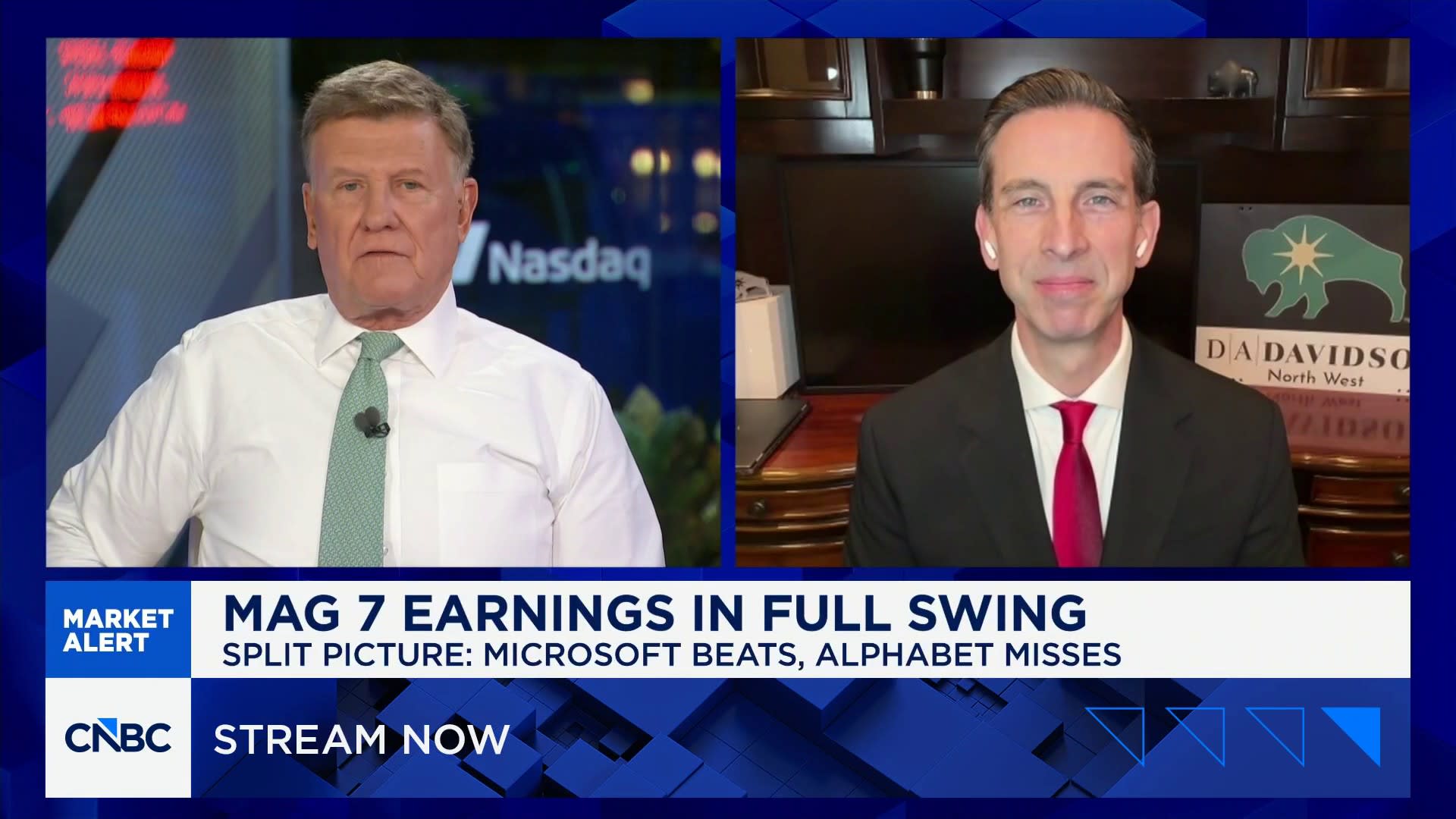
Alphabet tanks nearly 13% for worst day ever, losing $500 billion in value

Alphabet shares plunged the most since Google went public in 2004, dropping 13% on Thursday, wiping out roughly $500 billion in market cap.
In its earnings announcement late Wednesday, Alphabet reported negative free cash flow of $9.07 billion for the third quarter, compared to the $2.7 billion analysts expected. The Google parent maintained its full year capital expenditure guidance of between $195 billion and $205 billion.
Microsoft, meanwhile, traded largely flat as investors focused on the tech giants’ latest spending and free cash flow numbers in the third-quarter earnings report.
Microsoft reported $45.2 billion in capital expenditures and finance leases during the quarter, which was 30% higher than a year ago, but below analyst projections of $50.67 billion. Free cash flow fell 27% to $18.63 billion but remained positive.
The earnings reports come as investors scrutinize AI spending plans of tech companies and are focusing on the returns on those investments.
“Microsoft is building out its architecture in a measured way and as such contains fewer surprises,” Ben Barringer, global head of technology research at Quilter Cheviot, said on Thursday. “Alphabet, by contrast, saw its share price hit after hours as a result of a fairly messy set of results and a poorly handled earnings call” .
Search under pressure
Alphabet’s biggest source of revenue, search advertising, grew 12% in the September quarter to $63.35 billion, but missed analyst expectations, adding further pressure to the company’s shares.
Philipp Schindler, Alphabet’s chief business officer, said the impact on the search business was partly because of lower monetization within the company’s AI Mode. He added that Alphabet is now “scaling” ads within its AI Overviews and AI Mode products, including in international markets.
Google’s search business has faced headwinds from the rise of other AI chatbots like OpenAI’s ChatGPT and Anthropic’s Claude. People may be carrying out more search queries outside Google. Gemini, Google’s own AI chatbot, has failed to keep pace.
“The problem for Google is it faces an innovator’s dilemma and doesn’t know whether to protect its core business or look to join the disruption. As such, Google has lost its edge with Gemini and is behind peers on agentic AI,” Barringer said.
Google’s dominant market share in the search business, however, could ultimately give it a leg up over its peers, Rosenblatt Securities analyst Scott Devitt said.
“I don’t think it’s a sea change,” Devitt told CNBC’s “Squawk on the Street” on Thursday. “If it’s a problem for Alphabet, it’s a problem for any consumer-facing AI agent or LLM as well. And so, it’s a problem that I think is ultimately going to be resolved. And when it does, Alphabet, with its 4 billion search customers that become AI customers, is in an enviable position.”
– CNBC’s Robert Hum, Samantha Subin, Jordan Novet and Caleigh Keating contributed reporting.
Source – Middle east monitor


