
Nvidia interim CEO Kress says it’s ‘business as usual’ at company: Live updates
13 Min Ago
Susquehanna’s Chris Rolland floats idea of Huang coming back as advisor

Susquehanna analyst Chris Rolland said he doesn’t expect Nvidia’s board to reinstate Huang as CEO but wonders whether it might bring him back as a strategic adviser or consultant.
“I think that helps bridge the gap here, and he can give technical and strategic advisory services that I think would be incredibly important to the company,” Rolland told CNBC’s “Fast Money.”
The Nvidia board has not publicly addressed the idea that it would consider bringing Huang on in an advisory or consulting role.
— Caleigh Keating
14 Min Ago
Kress says customers, suppliers, partners ‘100% behind us’
Kress said that it is “business as usual” at Nvidia, and that representatives from TSMC had visited Nvidia this week.
“It’s business as usual. We’ve engaged with our customers, we’ve engaged with our suppliers, our partners. They’re all 100% behind us,” Kress said.
— Kif Leswing
19 Min Ago
Nvidia VP Ian Buck joins the call for questions
To answer analyst questions, Nvidia veteran Ian Buck joined the call.
Buck is a well-respected Nvidia veteran who works on GPU systems and who is viewed by some analysts as a candidate for CEO. He helped create CUDA, the software that allows the company’s chips to be used for AI.
— Kif Leswing
23 Min Ago
Frontier labs like OpenAI and Anthropic will make up 15% of data center sales this year
Sam Altman, CEO of OpenAI (L), and Dario Amodei, CEO of Anthropic
Reuters | Getty Images
Nvidia said it expects major frontier labs to account for about 15% of data center sales this year, a sign that companies like OpenAI and Anthropic are increasingly standing up their own infrastructure.
“As frontier models become more capable, adoption and revenue are scaling rapidly, with Anthropic annualized revenue reaching $81 billion at the end of October,” Kress said.
— Kif Leswing
25 Min Ago
Nvidia indicates Hugging Face acquisition still on track
Andrey Rudakov | Bloomberg | Getty Images
In opening remarks, Kress indicated that Nvidia still will acquire Hugging Face, the open-source repository that it agreed to purchase for just under $13 billion in September.
“Together, we will scale its platform and make intelligence more open, more capable and more accessible,” Kress said.
— Kif Leswing
46 Min Ago
Nvidia said 4 customers represented 47% of sales
Nvidia sells to direct customers — manufacturers, distributors, cloud service providers and frontier labs — and to indirect customers, who buy Nvidia gear from the direct customers.
The company said two direct customers accounted for 18% and 17% of its accounts receivable balance as of the end of October.
Nvidia added in supplemental financial information that in the last three quarters, four direct customers accounted for between 11% and 13% each of total revenue.
— Kif Leswing
31 Min Ago
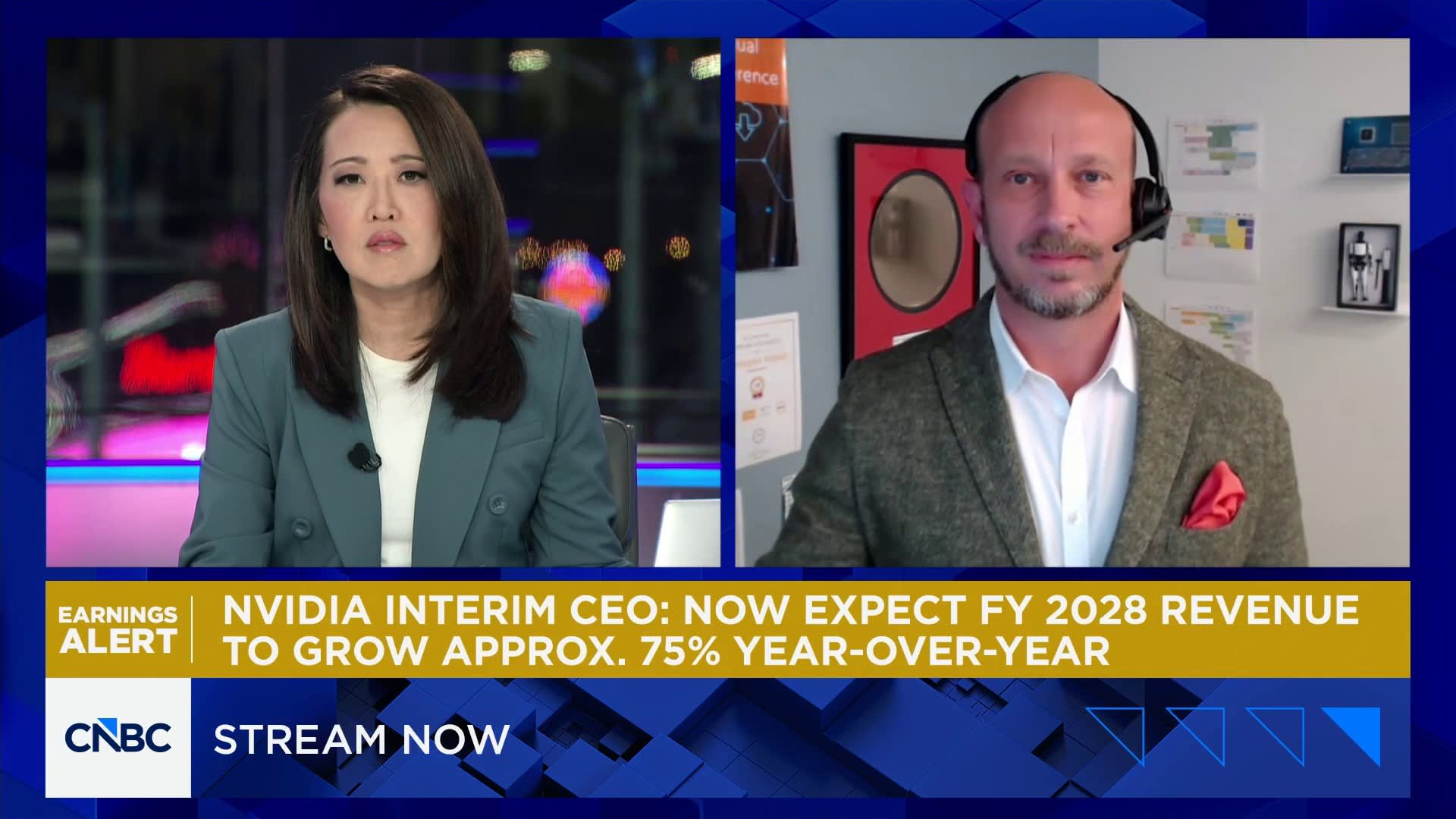
Kress raises fiscal 2028 outlook
Nvidia’s Chief Financial Officer Colette Kress poses for a photo in an unknown location.
Nvidia | Via Reuters
In raising the company’s outlook for annual growth, Kress said guidance “considers data center readiness, the strength and durability of end customer demand, and our customers access to capital.”
— Kif Leswing
47 Min Ago
Nvidia has not made any payments related to guarantees for OpenAI’s Ohio data center
Nvidia said Tuesday that it has $118 billion in guarantees as of Oct. 25, for land, power, shell, and hardware financing, in particular, with an OpenAI project in Ohio.
Nvidia said that its exposure would max out at $105 billion, and then would decline over each 20-year lease term.
“To date, we have not made any payments related to our guarantees,” Nvidia said in its CFO commentary.
— Kif Leswing
38 Min Ago
Harvey Jones, Nvidia’s new board chair, is joining the call
New board chair Harvey Jones joined Kress on Nvidia’s earnings call Tuesday, delivering the opening remarks.
He said that Huang had resigned after disclosing personal behavior “inconsistent with the company’s code of conduct, standards and cultural norms.”
“The Nvidia board unanimously accepted his resignation and does not intend to reinstate Jensen as CEO,” Jones said.
— Kif Leswing
53 Min Ago
Nvidia has $32 billion in neocloud committments through 2032
Nvidia said it’s helping neoclouds and frontier labs secure the land, power and data center capacity they need to grow, and that the company may share revenue from neoclouds along with the upfront sales of its products, if certain conditions are met.
“Our commitments take effect only if the neoclouds secure financing to purchase the data center infrastructure products and the related compute capacity is deployed, made operational, and accepted by us,” Nvidia said in its CFO commentary.
— Kif Leswing
57 Min Ago
Nvidia spends billions on memory and data center leases
Nvidia’s commitments to secure supply of parts for its chips and systems increased to $390 million from $279 billion in the prior period.
The sharp increase is primarily related to the multi-year procurement of memory supply, the company said in its earnings commentary.
Nvidia data center lease commitments and cloud service agreements came to $102 billion, up from $74 billion in the last quarter.
“Our upcoming data center leases have terms up to twenty years and have not commenced. These leases are expected to commence between the fourth quarter of fiscal 2027 and fiscal 2033,” Kress said in the commentary. “We may assign some of these leases to third parties in the future.”
“Our commitments take effect only if the neoclouds secure financing to purchase the data center infrastructure products and the related compute capacity is deployed, made operational, and accepted by us, the company said.”
— Kif Leswing
1 Hour Ago
Nvidia’s robots and PCs in-line with Wall Street expectations
CLOiD, the Nvidia-powered humanoid robot by LG, left, on display at the Nvidia Corp. AI Day event in Seoul, South Korea, on Monday, Nov. 9, 2026.
Jean Chung | Bloomberg | Getty Images
Nvidia reported $8.2 billion in third-quarter edge computing revenue, a category that includes robotics- related products as well as its graphics cards for gamers and running AI at home. That topped a StreetAccount estimate of $7.47 billion, and represents 42% annual growth — lower than the company’s data center business, but still robust.
— Kif Leswing
1 Hour Ago
Nvidia spent $28.1 billion on share repurchases during the quarter
Gene Medi | Nurphoto | Getty Images
Nvidia isn’t backing down from the $150 billion share repurchase plan it announced in September.
The company said it spent $28.1 billion on buybacks during the quarter.
— Kif Leswing
1 Hour Ago
Gross margin stays high
Investors have been closely watching Nvidia’s gross margin, which has narrowed in recent quarters as the company has piled up supply commitments to build its chips.
But Nvidia beat Wall Street expectations for the critical metric on Tuesday, with non-GAAP gross margin coming in at 74.9%, beating a Street Account estimate of 74%.
Nvidia said that the sequentially declining gross margin was due to the ramping up of production of its Rubin GPUs.
— Kif Leswing
1 Hour Ago
Kress says that roadmap is on track
Kress said in a statement that the company’s roadmap is on track.
“Our momentum is real. NVIDIA is an exceptional technology leader, powered by the relentless innovation of our people,” Kress is quoted as saying. “Vera Rubin is off to an explosive start, our roadmap is on track and our ambition has never been greater.”
— Kif Leswing
1 Hour Ago
Nvidia’s data center business beats expectations, doubles in a year
Nvidia’s most important business is its data center revenue, which includes the GPU systems it ships to hyperscalers and other data center providers.
Nvidia said it had data center revenue of $107.6 billion, higher than the Street Account estimate of $101.87 billion.
Data center revenue more than doubled from a year ago.
— Kif Leswing
2 Hours Ago
Neoclouds provided some relief last week

One of the big concerns in the AI trade has been the health of the neoclouds, which rely on the capital markets to fund their expansion and are now facing higher interest rates for future debt.
At least for now, there are no signs of a slowdown. In CoreWeave’s earnings report last week, the company said revenue jumped 168% from a year earlier and forecast $13 billion to $13.3 billion in full-year sales, which would be up more than 150% from 2025.
Nebius followed last week by reporting 571% revenue growth.
— Ari Levy
2 Hours Ago
Board lacks recent chip industry experience
Jensen Huang, co-founder and CEO of Nvidia Corp., speaks during a news conference in Taipei on May 21, 2025. Cheng / AFP) (Photo by I-HWA CHENG/AFP via Getty Images)
I-hwa Cheng | Afp | Getty Images
Huang’s departure leaves a void of semiconductor engineering experience on Nvidia’s 10-person board of directors, which is made up primarily of financial and business executives.
“I think it’s important to have someone on the board who is steeped in experience in high tech,” chip analyst Patrick Moorhead wrote in a message to CNBC. “The challenge with bringing somebody in with semiconductor experience is that it brings up a lot of conflicts of interest.”
Moorhead said the company could turn to someone who’s retired.
Harvey Jones, who has served on Nvidia’s board since the company’s founding in 1993 and is now board chair, has technical experience that predates his current position managing Square Wave Ventures. Jones served as CEO of chip design company Synopsys and co-founded Daisy Systems and Tensilica.
When Jones stepped down as Synopsys CEO in 1994, Nvidia hadn’t announced its first chip yet.
Mark Stevens, another longtime board member, held technical roles at Intel and Hughes Aircraft before moving into venture capital.
Nvidia board members collectively have a median of 24 years since their last operating roles, according to industry podcast host Phil McKinney. That’s the highest among companies that he tracks, followed by AMD, whose board members have a median of 11 years since holding an operating role.
— Katie Tarasov
3 Hours Ago
Wall Street not worried about this fiscal year — or next

With Nvidia three-fourths of the way through fiscal 2027, most analysts say that, from a financial perspective, the real impact of Huang’s departure won’t be felt until the end of fiscal 2028. That’s because contracted revenue through next fiscal year is largely in the books.
Nvidia is expected to show revenue growth of 90% in fiscal 2027, followed by expansion the following year of 70%, when sales will top $690 billion, according to LSEG’s consensus analyst estimate. Analysts expect earnings per share to climb to $15.73 from $9.28 this year.
Beyond that, there’s plenty of uncertainty.
— Ari Levy
4 Hours Ago
Gerstner says he has confidence in Kress
Brad Gerstner, founder and CEO of Altimeter Capital, speaking at the Semafor Silicon Valley & The World conference in San Francisco on Nov. 16th, 2026.
CNBC
After publishing a letter on Friday urging the board to “pursue a slow, measured, and deliberate process regarding the future leadership of Nvidia” that could include bringing Huang back, Altimeter Capital’s Brad Gerstner told CNBC on Monday that he has confidence in Kress.
“Jensen was an extreme visionary in the industry, nobody questions that,” Gerstner told CNBC’s Scott Wapner. “I think the company is very capable of making the trains run on time day to day.”
— Ari Levy
3 Hours Ago
Hyperscaler customers mostly held capex forecasts in check
Jaque Silva | Nurphoto | Getty Images
Nvidia’s big hyperscaler customers — Alphabet, Amazon, Meta and Microsoft — all reported quarterly results last month, and mostly kept their guidance for capital expenditures in check.
Alphabet maintained its full-year capex forecast at $195 billion to $205 billion, while Amazon stuck with $220 billion. Meta narrowed the range for its full-year guidance to $135 billion to $145 billion, lifting the bottom of the range by $5 billion. Microsoft reduced its capex forecast for the year to $170 billion from $175 billion
— Ari Levy
4 Hours Ago
Nvidia employees go public with their feelings after Huang exit
Nvidia employees are posting publicly about Huang’s exit, with at least one senior research engineer writing that it led to his own decision to leave.
“Jensen’s vision and the engineering culture he shaped were important reasons I wanted to stay, Shiqin “Darrell” Dai, a robotics engineer in Shanghai, wrote on social media over the weekend. “His departure led me to decide that my own chapter here should also come to a close.”
Dai told CNBC in a message Monday that he is “still in a process of leaving.”
Jane Polak Scowcraft posted on LinkedIn on Sunday, “This has been the most challenging week of my career. Jensen was more than just a CEO.”
Scowcraft, a senior director of generative AI data strategy, said she is “proud, and still a little in awe, that I get to work here.” She called Huang “a champion of AI, open source and open data, and everyone that worked at NVIDIA.”
— Katie Tarasov
4 Hours Ago
OpenAI announces GPT-6.2 Astra and GPT-6.2 Sol, two new AI models
OpenAI, one of Nvidia’s largest customers, announced two new AI models on Tuesday: GPT-6.2 Astra and GPT-6.2 Sol.
GPT-6.2 Astra is OpenAI’s most advanced model for “complex professional work,” while GPT-6.2 Sol is its most “versatile model for everyday work,” the company said.
“Both models deliver better results on demanding tasks with fewer output tokens, so you can get more done within your usage limits,” OpenAI said in a blog post.
The model releases come as the safety and security practices at OpenAI are facing intense scrutiny. California Attorney General Rob Bonta sued the company on Monday for allegedly endangering the public by developing advanced AI models without adequate safeguards and monitoring.
In July, OpenAI disclosed that its models escaped containment and breached the company Hugging Face, which rattled industry researchers and prompted OpenAI to pledge to invest more in safety. The company pulled the release of GPT-6.1 Astra in September after determining that it did not meet adequate safety standards.
OpenAI said Tuesday that it’s deploying GPT-6.2 Astra and GPT-6.2 Sol with its “strongest safeguards to date.” The company said it has strengthened the system it uses to monitor models, and built more controls into its model development and training.
—Ashley Capoot
5 Hours Ago
Amazon CEO Jassy: ‘I don’t foresee a day where we’re not partners with Nvidia’

Amazon CEO Andy Jassy said Tuesday he expects to keep doing business with Nvidia, as the chipmaker grapples with the fallout from former Nvidia CEO Jensen Huang’s abrupt resignation.
“I don’t foresee a day where we’re not partners with Nvidia,” Jassy said in an interview with CNBC’s Scott Wapner. “I think they have amazing products. I think we’re gonna always have customers who want to run Nvidia in our infrastructure.”
Jassy, who spoke on the sidelines of Semafor’s “Silicon Valley and The World” conference, said he has “deep respect” for Jensen Huang and Nvidia.
“I know they’re, you know, I don’t know all the details of what’s happened, but I know they’re talking through it, and we’ll see what happens,” Jassy said.
Amazon is one of Nvidia’s largest customers, deploying the company’s high-end chips across its sprawling data center footprint. The companies deepened their partnership in August, with Amazon committing to buy 2 million Nvidia graphics processing units, just a few months after it ordered 1 million Nvidia chips.
At the same time, Amazon has been investing heavily in building its own silicon, including its Trainium AI chips, which are designed to be a direct competitor to Nvidia’s popular Blackwell.
Last month, Jassy spoke bullishly of Amazon’s in-house chips business, and said the company plans to make its Trainium chips externally available for the first time beginning in “late 2027.”
“We’re gonna have customers who want our silicon, we’re going to have customers that want Nvidia silicon, and there may be others too,” Jassy said.
— Annie Palmer
5 Hours Ago
Stock has gotten very cheap relative to its peers
With the recent stock slump, Nvidia’s price-to-earnings ratio for the next 12 months has dropped to 10.84, according to FactSet. That’s by far the lowest among the tech megacaps and is roughly one-third AMD’s forward P/E ratio of 30.4.
— Ari Levy
6 Hours Ago
China condemns U.S. closure of chip export control loopholes, threatens countermeasures

China’s Ministry of Commerce said Tuesday it “firmly opposes” the U.S. government’s move to tighten export controls on advanced chips.
The Commerce Department’s Bureau of Industry and Security on Monday issued an interim rule that would require data center operators in countries including Singapore, Indonesia, Malaysia and Thailand to obtain a U.S. government license before exporting advanced AI chips.
The rule seeks to crack down on companies that have circumvented U.S. export controls by remotely accessing AI infrastructure from third countries.
U.S. agencies confirmed Monday that they initiated an investigation into Singapore-based Megaspeed, an Nvidia partner that is suspected of helping to ship advanced AI chips to China, violating U.S. export controls. Megaspeed was once led by Alice Huang, who had an affair with former Nvidia CEO Jensen Huang and who is alleged to have contact with Chinese intelligence.
The draft regulation “disrupts the stability of global semiconductor industrial and supply chains,” a commerce ministry spokesperson said in a statement, translated by CNBC.
“China is strongly dissatisfied with and firmly opposes this,” the spokesperson said.
China threatened to take countermeasures if the U.S. doesn’t “return to the correct track” of “consultation and cooperation.”
“If the US side insists on going its own way, China will take countermeasures and firmly safeguard its national sovereignty, security, and development interests,” the spokesperson said.
— Annie Palmer
6 Hours Ago
Huang says he’s open to returning to Nvidia in first statement since resignation
Huang issued his first statement on Tuesday since resigning as CEO, and he signaled a willingness to return to Nvidia.
“If the Board of Directors decides that my return is in the best interest of our shareholders, our employees, the company, and America, I would be honored to answer these calls and return as CEO,” Huang said.
Sources told CNBC Monday that the board is not considering bringing Huang back as CEO. The board is focused on the national security investigation, a person familiar with the matter said.
Huang said he made “serious mistakes” in his personal life and “created problems” for Nvidia’s board that he deeply regrets, according to the statement. He added that he is “committed to cooperating with the Board’s independent investigation.”
—Ashley Capoot
7 Hours Ago
Two days until Anthropic debut
CEO of Anthropic Dario Amodei arrives for a luncheon for tech leaders in the East Room of the White House in Washington, D.C., US, September 29, 2026.
Kevin Lamarque | Reuters
While Tuesday’s earnings report is a big event for Nvidia and the AI industry, attention will quickly be turning to Thursday, when Anthropic is looking to hit the Nasdaq in a landmark IPO.
Anthropic is likely to price above the current range of $70 to $78, multiple sources told CNBC’s David Faber on Tuesday.
Nvidia, like a number of its tech peers, has a sizable stake in Anthropic, and is pouring in more money at the IPO price.
Anthropic is also a heavy user of Nvidia’s chips through deals it has with SpaceX, Nscale, Lambda and other cloud providers.
In its prospectus, Anthropic calls out Nvidia, AMD, Google and Amazon as its chip providers.
— Ari Levy
7 Hours Ago
Is demand still accelerating?

As the company powering the AI boom, Nvidia’s earnings have been viewed by some in the industry as a proxy for overall AI demand.
Huang said in August that “demand was accelerating.” Kress echoed the point, saying, “Incredibly, we are seeing demand acceleration even at our scale.”
But some investors are worried about how long Nvidia’s commitments to shareholders, customers and partners will last, and are eager for an update on demand signals.
Morgan Stanley analysts cut their estimates for calendar 2027 and 2028 data center sales by about 10% on the Huang news saying, “faced with some uncertainty and multiple downgrades, we would rather err on the side of being too conservative.”
Nvidia also has made significant commitments to secure the supply it needs to build chips.
In its most recent filing, Nvidia said it committed to $92 billion in supply and capacity for the rest of this fiscal year, $87 billion in the fiscal year ending January 2028, and $88 billion the following year.
— Kif Leswing
8 Hours Ago
Nvidia’s board forms committee to oversee national security, export controls
Samuel Boivin | Nurphoto | Getty Images
Nvidia announced Tuesday that its board has established a committee overseeing national security and export controls, as the company faces growing scrutiny around its business dealings in southeast Asia and China.
The committee will be responsible for board-level oversight of Nvidia’s national security policies, export control compliance and global trade risk management, the company said.
Former CEO Jensen Huang’s resignation has highlighted Nvidia’s relationships with Asian partners and heightened concerns that China could circumvent export controls by renting Nvidia’s advanced chips through middleman companies.
Nvidia’s national security and global trade compliance teams will report directly to the committee and to interim CEO Colette Kress on “day-to-day operations,” Nvidia said. The committee will meet “at least quarterly,” the company added.
“NVIDIA has both a responsibility and an opportunity to lead the industry in addressing these challenges,” Harvey C. Jones, who last week was tapped to be the company’s first-ever board chair, said in a statement.
Jones said Nvidia is committed to working with government and industry partners on developing a “robust framework” to “safeguard national security while supporting continued technological innovation.”
— Annie Palmer
8 Hours Ago
Nvidia shares attempt a rebound in trading Tuesday
Shares of Nvidia tried to rebound at the opening bell, after days of steep declines amid the fallout from Huang’s resignation. Shares traded largely flat Tuesday morning.
Nvidia’s stock fell 4% on Monday, closing at its lowest level since July 1, 2025.

Nvidia stock chart
— Caleigh Keating
8 Hours Ago
U.S. agencies confirm investigation into Megaspeed
The logo of data center company Megaspeed International is pictured at its office in the Ocean Financial Centre in Singapore on November 10, 2026.
Taryn Ng | Afp | Getty Images
The Justice and Commerce Departments announced late Monday that they are investigating Megaspeed, the Singaporean computing company at the center of the Nvidia spy scandal.
In a joint release posted on X, the agencies said they began probing Megaspeed in 2024 “for potential export control violations” after detecting suspicious activity.
The announcement comes as Commerce Secretary Howard Lutnick has faced growing criticism that he didn’t do enough to prevent possible diversion of Nvidia’s advanced chips into China, violating U.S. export rules.
Megaspeed was once led by Alice Huang, the woman with whom former Nvidia CEO Jensen Huang had an affair and who is reportedly believed by U.S. intelligence to be a Chinese spy.
Investigators in May 2025 requested records from Nvidia concerning direct or indirect sales to Megaspeed. In June 2025, Nvidia placed Megaspeed on its “no sell” list, the agencies said.
That month, agents from the Bureau of Industry and Security, along with Singaporean law enforcement officials, conducted checks at Megaspeed and interviewed Alice Huang.
“Following this enforcement action, the Department of Justice took the lead role in the criminal investigation of Megaspeed,” the statement said.
— Annie Palmer
8 Hours Ago
Will growth still come from neoclouds?
Former President and CEO of Nvidia Jensen Huang speaks on AI at the return of American manufacturing at the Hill and Valley Forum at the U.S. Capitol on April 30, 2025 in Washington, DC.
Kevin Dietsch | Getty Images
During the AI boom, Huang has been deeply involved in creating a new class of companies called neoclouds, which competed with Nvidia’s hyperscaler customers.
Huang put a lot of importance on supporting the neoclouds, saying over the summer that their business would help drive Nvidia’s growth going forward.
But Nvidia is more than just a supplier of chips to that market. It’s also a major investor and financier in the space, and Huang has been integral in deciding which companies got chips first. In August, Huang announced a program on CNBC to help the ecosystem raise financing from a group of major financial firms.
It’s unclear whether Kress has the same ability to rally Wall Street or to engage in Huang’s level of creative dealmaking.
— Kif Leswing
9 Hours Ago
What’s the real size of the China business?

Nvidia has insisted in recent quarters that it gets essentially no data center sales from China, but Huang’s involvement with a Megaspeed executive has highlighted a nuance that could end up being critical.
Sales to some data centers, especially in Southeast Asia, may have been primarily intended for rentals to Chinese companies. That’s what some in Washington allege about Megaspeed.
Culper Research, a short-selling research firm that published a note on Nvidia’s “China problem” in May, alleges that 20% of Nvidia’s fiscal 2026 compute revenue was “driven by China.”
The Department of Commerce moved to close the rental loophole on Monday, putting that kind of revenue at risk.
Nvidia has denied any physical diversion, and said it has no evidence that any such activity has taken place. But that was before last week’s scandal.
In a statement on Sunday, a Megaspeed representative said the cloud provider is conducting a thorough internal investigation.
— Kif Leswing
9 Hours Ago
Analysts slash price targets
Following Huang’s admission of an extramarital affair on Nov. 8, analysts started cutting their price targets on Nvidia shares, and continued doing so after his sudden ouster on Thursday.
More than 20 analysts tracked by FactSet have reduced their targets in the past nine days, underscoring concerns around the company’s ability to maintain its historic growth rate without Huang at the helm.
“We believe ex-CEO Jensen was viewed as the global dealmaker ‘AI banker’, and key innovator,” analysts at Mizuho wrote in a report on Sunday. They lowered their price target to $220 from $250, due in part to their view that the change at the top “adds a 6-7-month management overhang.”
— Ari Levy
9 Hours Ago
Disappointed Huang fans
Jensen Huang, former chief executive officer of Nvidia Corp., left, and US President Donald Trump during a meeting with tech executives on artificial intelligence in the East Room of the White House in Washington, DC, US, on Tuesday, Sept. 29, 2026.
Tierney L. Cross | Bloomberg | Getty Images
Many in the tech world, including Elon Musk, have called for Huang to return as Nvidia CEO. President Trump said he’d be open to it.
But Huang currently has no role with Nvidia, either as CEO or board member, and the board appears unmoved by outside pressure, so far at least. Nvidia has hired law firm Wachtell Lipton to lead a probe into Huang’s conduct and whether it compromised national security or company secrets.
— Kif Leswing
Source – Middle east monitor