
Where’s the growth? Legacy automakers face a tougher 2027 as costs rise, market tightens
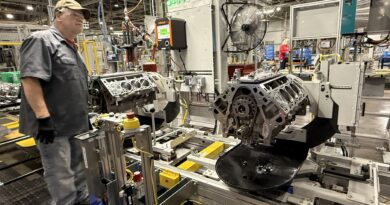
Workers at Ford’s Kentucky Truck Plant on April 30, 2025.
Michael Wayland | CNBC
DETROIT — There’s a growing concern that the global automotive industry may be stuck in neutral, if not reverse, heading into 2027.
The auto industry — from the companies to their customers — has been surprisingly resilient this decade, but there are fears that rising costs, weaker vehicle pricing and a more challenging market could threaten profits and growth going forward.
Automakers also face pressure outside the U.S. from an onslaught of Chinese carmakers, a thinner new-product pipeline after retreating from some all-electric plans, and company- and region-specific challenges.
“With investor focus increasingly shifting to 2027, the setup appears challenging,” Barclays analyst Dan Levy said in an investor note last month. “Rising inflation, continued China pressure, affordability concerns in the U.S., and a flat global production outlook suggest another year of limited earnings growth.”
Several Wall Street analysts have said automakers will need continued pricing strength and additional cost savings to offset inflation, higher investment spending and a potentially weaker economy just to maintain their current levels.
“It’s a little bit more optimistic in the U.S. and then very pessimistic in Europe,” RBC Capital Markets analyst Tom Narayan told CNBC. “As a whole, there’s some negativity on ’27.”
Guidance cuts, increased costs
Automakers from the U.S. to Europe to Asia have been facing a growing list of headwinds.
For U.S.-based legacy automakers, Ford Motor said it expects next year’s results to be in line with 2026, while General Motors grew more cautious about its ability to continue growing earnings as much as it had previously expected.
“We continue to believe that 2027 will be another strong year and better than 2026, assuming customer demand remains strong, and commodity, logistics and other recent cost pressures moderate,” GM CEO Mary Barra told investors Oct. 20.
GM CFO Paul Jacobson said that while it’s too early to officially forecast, the company is facing additional inflationary costs that could lead to another $2 billion headwind in 2027, like it expects this year. He specifically cited costs of commodity inflation, logistics and DRAM, or dynamic random-access memory chips as challenges.
Those chips are critical components in modern vehicles and are used for everything from temporary data storage and real-time processing from infotainment systems to safety-critical systems.
GM and others have been able to offset outside pressures through cost cuts, operational efficiencies and resilient consumer demand for higher-margin vehicles. However, there’s a limit to what companies can do.
“There’s only so much pricing you can push to consumers,” Narayan said. “They’re already at pretty high pricing.”
European automakers including Volkswagen, Mercedes-Benz and BMW in recent weeks reduced their 2026 earnings forecasts in response to U.S. tariffs, the growth of Chinese automakers and rising costs.

Most recently, BMW this week said accelerated restructuring measures would reduce its automotive pretax earnings margin this year by 2.5 percentage points. The company said the restructuring should support “positive effects” into 2027 and a 3% to 5% pretax profit margin for 2028. That compares with a 5.3% automotive margin last year and 3.4% during the third quarter.
Chrysler parent Stellantis, which has large operations in Europe and the U.S., is facing its own challenges, as it’s in the midst of a restructuring that aims for a low-single-digit adjusted operating margin this year. It has maintained a 2026 guidance that includes a mid-single-digit percentage increase in net revenue and a low-single-digit adjusted operating margin.
In Asia, South Korean automaker Hyundai Motor, which has experienced notable growth in recent years, also cut key metrics when it reported earnings late last month. The company lowered its 2026 wholesales target to 4 million vehicles, down from 4.16 million, and cut its operating-margin target to between 5.5% and 6.5%, down from a previous goal of 6.3% to 7.3%.
Toyota Motor is an outlier for its most recent quarter and outlook, as the world’s largest automaker increased its full-year operating income forecast by 500 billion Japanese yen (about $3.2 billion) on Thursday.
Toyota’s results were boosted by weakness in the Japanese yen as well as strong hybrid vehicle demand in the U.S. However, the increase in operating income was its first in six quarters.
Broadly, the changes to earnings and outlooks come as production for the global industry slows.
Consulting and insights firm GlobalData expects global light-vehicle production of about 90.96 million units in 2026, down 2.1% compared with last year. It forecast a production increase of less than 1% next year. That comes on the heels of strong annual growth earlier this decade, led by China.
Caution lights
Cox Automotive reported the average transaction price of a new U.S. vehicle in September was more than $50,500. That was just shy of the record of $50,614 in December 2025.
Lofty vehicle prices have led to record-high and record-long financing deals, as well as concerns that customers are getting priced out of the new-vehicle market.
Employees of German car maker Volkswagen wave flags and display banners as they take part in a rally called by German trade union IG Metall to protest against restructuring and mass job cut plans at the VW plant in Zwickau, eastern Germany, July 9, 2026.
Jens Schluter | Afp | Getty Images
The typical U.S. new-vehicle payment reached $776 a month in September, the highest since December 2023, according to Cox Automotive.
Cox Automotive chief economist Jeremy Robb, discussing the third quarter for the automotive industry, rated the overall economy, buyer ability and borrowing costs as cautionary “yellow lights.”
But he did have some “green lights,” such as good credit availability and employment conditions, which could give some relief for automakers and consumers, many of whom need vehicles for their everyday lives.
Robb said there’s a “tug-of-war” between headwinds such as rising costs, interest rates and fuel prices and tailwinds such as growth in liquid assets and savings that has helped offset some of the additional costs.
“Consumers remain under financial pressure, but the vehicle demand continues to hold, showing more resiliency in the auto industry than we’ve seen in other parts of the economy,” Robb said during a Sept. 24 call, noting consumer sentiment remains low.
Source – CNBC