
What’s on tap for the Thai shrimp industry?
The shrimp industry has become a hot topic for the government after Malaysia suspended imports of Thai shrimp on June 1. Although this trade dispute may soon be resolved following meetings in early July, Thailand’s shrimp industry continues to grapple with a longstanding and more significant challenge that has persisted for more than a decade.
The Explainer examines the industry’s importance to Thailand’s economy, the major challenges it faces, and potential solutions to support its sustainable recovery and growth.
How much shrimp does Thailand produce each year?
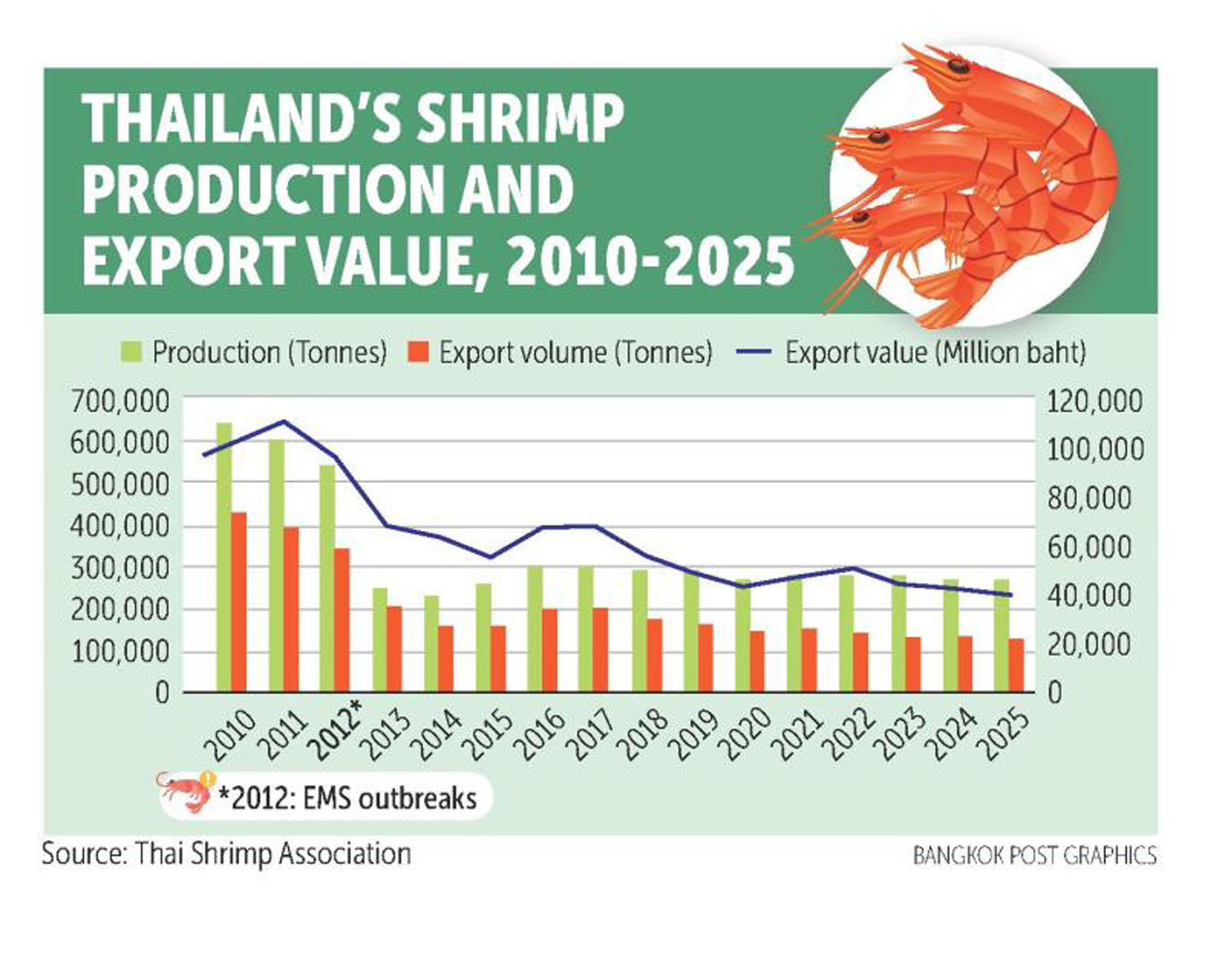
Ekapoj Yodpinit, president of the Thai Shrimp Association, said Thailand was once the world’s largest producer and exporter of shrimp. At its peak in 2010, the country produced 640,000 tonnes of shrimp annually, with exports valued at more than 110 billion baht.
However, following the outbreak of early mortality syndrome (EMS) in 2012, the industry has suffered severe setbacks. Annual shrimp production has fallen to around 270,000-280,000 tonnes, while export value has dropped to about 40 billion baht a year.
In 2025, roughly 48% of production was for export, with the remainder consumed domestically.
At the beginning of this year, the industry set a production target of 400,000 tonnes. If that target is achieved, shrimp exports could exceed 250,000 tonnes.
Why did Malaysia suspend Thai shrimp imports?
The suspension primarily stems from trade countermeasures and Malaysia’s strengthened national food safety requirements.
In May, Thailand restricted imports of Malaysian sea bass over concerns about chemical residues, prompting Malaysia to temporarily ban Thai shrimp, citing food safety controls.
The ban, which took effect in June, affects five species: whiteleg shrimp (vannamei), black tiger shrimp, tiger prawn, banana shrimp and blue shrimp.
Malaysian authorities said in June the ban will remain in place until Thai agricultural agencies submit a completed food safety standards questionnaire for a formal reassessment.
What is the impact of the suspension on Thailand’s shrimp industry?
According to Kasikorn Research Center (K-Research), Malaysia is Thailand’s 11th-largest export market for shrimp products, accounting for around 1% of Thailand’s total global shrimp exports. Fresh, chilled and frozen shrimp account for 97% of shipments to Malaysia, while the remaining 3% consists of processed shrimp products, including canned shrimp.
Mr Ekapoj estimated before the suspension, Thailand exported up to 100 tonnes of shrimp to Malaysia daily, or about 3,000 tonnes per month.
K-Research noted while Malaysia represents only a small share of Thailand’s shrimp exports, the suspension adds pressure on the sector, which is already facing slowing orders from trading partners and intense global competition.
The ban has forced exporters to seek alternative markets for products previously destined for Malaysia, while intensifying downward pressure on farm-gate shrimp prices.
Mr Ekapoj said since the ban took effect, farm-gate shrimp prices have dropped by 50-60 baht per kilogramme. However, prices have rebounded by 20-30 baht per kg from their lowest level as domestic supply declined after the harvest season in the southern region.
Since the ban, he said domestic retail shrimp prices have not fallen as much as farm-gate prices due to additional costs such as transport.
How are both countries addressing the issue?
Agriculture and Cooperatives Minister Suriya Juangroongruangkit held discussions with Malaysia’s Minister of Agriculture and Food Security Datuk Seri Mohamad Sabu on July 1.
Mr Suriya said the countries agreed to expedite the inspection process related to sanitary and phytosanitary requirements, including chemical residue and hygiene checks, to restore trade activities.
If the process proceeds as planned, he said he expects Thailand to resume shrimp exports to Malaysia within 30 days.
After meeting with Malaysian Prime Minister Anwar Ibrahim in Putrajaya on July 10, Thai Premier Anutin Charnvirakul reaffirmed Mr Suriya’s statement.
Following these discussions, Thailand and Malaysia must establish task forces to oversee implementation details, according to Mr Ekapoj.
What other challenges does the shrimp industry face?
Disease outbreaks are the biggest challenge for shrimp farmers, he said. Major diseases such as white spot disease, EMS, white faeces syndrome and yellow head disease have significantly reduced farming success.
“These diseases have become a hidden expense, driving production costs above those of competitors and weakening Thailand’s competitiveness,” said Mr Ekapoj.
In many cases, farmers are unable to harvest all their shrimp as some die before the harvest period.
Moreover, he said Thailand has a shortage of shrimp breeds adapted to local conditions, which require strains that offer both disease resistance and rapid growth.
Declining shrimp output has also affected cold storage operators and processing plants, which have been unable to operate at full capacity or meet order demands.
 How can Thailand revive the shrimp industry and make it grow sustainably?
The government and relevant agencies must work together to address disease problems, said Mr Ekapoj.
“Farmers have attempted to solve this problem by themselves for years, but were unsuccessful,” he noted.
Shrimp farmers believe science can resolve persistent disease and have urged research institutions and the government to adopt a more coordinated and practical approach, said Mr Ekapoj.
The government should serve as a central coordinator, bringing together leading researchers from universities nationwide who currently work in isolation to collaborate on developing systematic and sustainable solutions to farming challenges, he noted.
Mr Ekapoj cited Ecuador as an example of successful innovation. Despite facing similar disease outbreaks, the country overcame challenges by investing in R&D to develop shrimp strains that are better adapted to local conditions and more resistant to disease.
“Adequate budgets and integrated collaboration across sectors are essential,” he said.
“We need cooperation between academic institutions and both local and international research institutes to solve this problem.”
The industry requested the government allocate roughly 5.5 billion baht to implement the strategies and initiatives under the draft National Action Plan for Addressing Challenges in the Marine Shrimp Industry (2026-2030).
The measures cover: farm water management; development and control of production inputs such as baby shrimp and feed; disease monitoring, prevention and control; productivity improvement and cost reduction; R&D; human resources development and technology transfer; production standards; marketing and processing; international trade negotiations; and collaboration between the public and private sectors.
Mr Ekapoj said he is confident these measures will help effectively address the industry’s problems and strengthen Thailand’s position in the global shrimp market, and expressed hope the government will approve the budget to support the industry.
Source – Bangkok News